The mind-boggling Commercial Magnitude of an IPL cricket season


IPL Season 2026 with verified historical accounts and transparent revenue scenarios


CA. S. Muralidharan, Business Mentor and Thought Leader


Evidence reviewed as at 4 October 2026. All rupee figures are in crore unless stated otherwise.


Long before the first ball is bowled, the season has begun commercially. A broadcaster has bought the right to carry the contest into homes. Brands have purchased visibility. Franchises have contracted players, and spectators are buying their seats. The evening at the stadium is the visible part of a much larger financial arrangement.


My central finding is that IPL operates at a recurring commercial scale exceeding Rs 10,000 crore on simple annualised media and title-sponsorship contract benchmarks alone. Reporting on the 2026 valuation study projects season revenue above US$1.8 billion. These are different measures: the first is a contract calculation; the second is a reported industry projection whose consolidation perimeter has not been independently established. Neither is an audited consolidated 2026 income statement. [1–4]


The available evidence is sufficient to explain the magnitude and business model, but does not justify an exact audited total for the latest season. This study therefore distinguishes 2026 contracts and estimates, historical audited results, and illustrative calculations. Ticket collections and stadium advertising are included with their correct accounting treatment.


The money behind a season


The official media-rights contract for 2023–2027 is Rs 48,390.32 crore. Dividing by five gives Rs 9,678.06 crore per season. Tata title sponsorship for 2024–2028 is Rs 2,500 crore, equivalent to Rs 500 crore a year on the same simple basis. Together they imply Rs 10,178.06 crore annually before other commercial categories. Actual seasonal recognition and payments may differ from these averages. The 2026 schedule provides 70 league matches and four playoffs. Dividing the contract benchmark by 74 gives roughly Rs 137.54 crore per scheduled match, a scale comparison rather than a contractual per-match price. [1,2,5]


Season revenue above US$1.8 billion, reported in coverage of Houlihan Lokey’s 2026 study, includes broadcasting, sponsorship and ticket sales. At an illustrative Rs 90 per dollar, US$1.8 billion is Rs 16,200 crore. This exchange rate is a display assumption, not a verified transaction-date rate, and the projection should not be promoted into an audited fact. [4]

Houlihan Lokey separately estimates IPL business enterprise value at US$20.6 billion and standalone brand value at US$4.3 billion in 2026. Valuation measures anticipated future benefits; it is not money earned in one tournament. Brand value must not be added to enterprise value. The announced Rs 16,660 crore RCB company transaction also covers both IPL and WPL franchises. Its ownership-transfer consideration belongs outside recurring season revenue. [3,6]


What the organiser accounts establish


BCCI’s audited FY2024–25 Schedule 8 reports an IPL 2024 account with total income of Rs 12,005.55 crore and expenditure of Rs 6,892.73 crore. The resulting Rs 5,112.82 crore surplus precedes financial-year allocation adjustments. The final IPL surplus transferred into the financial-year income-and-expenditure account is Rs 5,070.55 crore. These are historical organiser results, not IPL 2026 results and not consolidated profits of the entire cricket economy. [7]
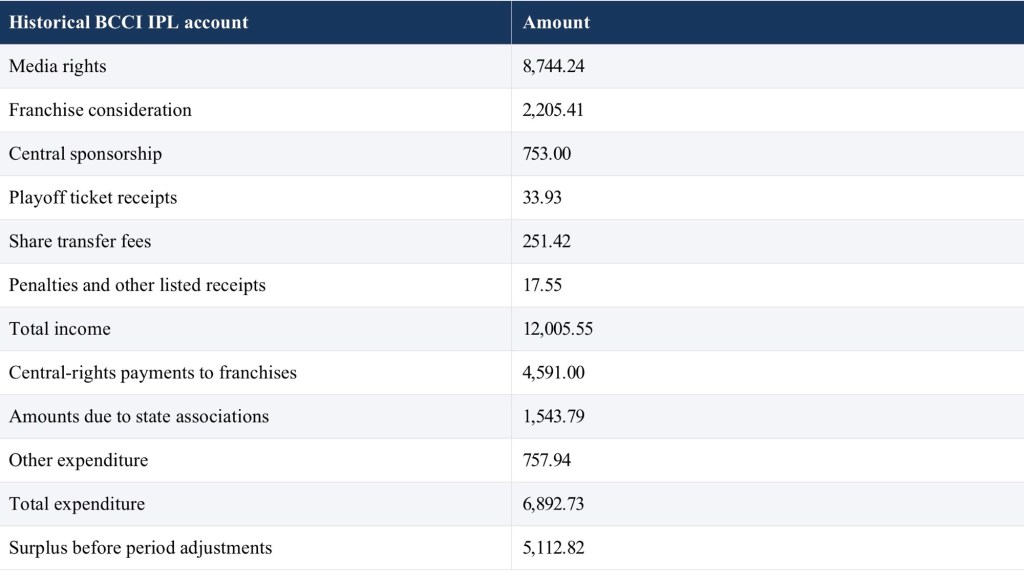
Average Season’s income and expenditure

Source: BCCI FY2024–25 Schedule 8. Other expenditure and the grouped receipts are arithmetic residuals from the published schedule. [7]


This account shows where the money goes. A substantial part is distributed to franchises, while state associations also receive allocations. Those allocations are transfers within cricket institutions; they do not establish how much was subsequently spent on grassroots cricket or infrastructure.


Why the accounts cannot simply be added


If a broadcaster pays BCCI Rs 100 and BCCI passes Rs 50 to a team, the combined external income remains Rs 100. Recording Rs 150 would count part of the same money twice. When a team pays its franchise fee back to BCCI, that is another internal transaction to eliminate.


A correct combined league statement adds organiser income and IPL-only team operating income, then removes central-rights distributions, franchise consideration and other reciprocal transactions. Prize and playoff distributions also need matching eliminations. It must align seasons, exclude WPL and overseas leagues, and use consistent treatment of GST, hospitality, related-party deals and exceptional fees. Adding broadcaster advertising revenue to the league’s rights income would likewise mix successive stages of the value chain. A wider ecosystem account would have to consolidate those stages too.


Consequently, the earlier Rs 6,066 crore ten-company sum is retained only as an indicative sum of reported company operating revenues. The incomplete Rs 650.81 crore profit subtotal is withdrawn as a measure of IPL profitability. It combines unverified figures and differing business boundaries, with SRH profit missing. It should not be used as an overall league earnings claim.


Ticket sales and gate collections


Ticket income is additional external revenue when spectators or companies buy admission and hospitality. The crucial distinction is between home-match collections in franchise accounts and playoff collections in BCCI’s account. BCCI reports Rs 33.93 crore of IPL 2024 playoff ticket income, net of GST, based on the ticketing agency’s CA certificate. That figure covers playoffs, not the season’s entire gate collection. For 2026, BCCI appointed District by Zomato for playoff ticketing, but its announcement does not disclose the final receipts. [5,7]
A packed ground does not automatically mean every seat was sold. Complimentary allocations, blocked seats, refunds and premium boxes affect realised collections. Corporate hospitality must be separated into admission and services if the accounting requires it; premium-seat revenue must not be added again when already included in ticket yield. Resale prices are not franchise ticket revenue.

Formula: matches × paid attendees × net yield ÷ 10,000,000. The middle case represents 22.2 lakh paid visits and Rs 6 crore per match. For seven home matches, that arithmetic is Rs 42 crore. These are gross operating receipts before stadium rent, ticketing charges and match costs; they are not profit. Since all 74 matches are modelled, playoff receipts must not be added again. The three cases are scenarios, not a statistically validated range.


Advertising inside the stadium


The boundary board visible on television reaches viewers far beyond those in the ground. Its commercial value therefore depends on both stadium exposure and broadcast exposure. Central league sponsorships and permitted team sponsorship packages may include signage, dugout branding, screens, activation space or hospitality. Historical franchise-rights descriptions and official partner-rights notices show that the league controls important stadium assets.


Local stadium advertising needs a separate reconciliation, not an automatic extra line. If a brand pays Rs 10 crore for a package covering kit branding and signage, the revenue is Rs 10 crore. Assigning Rs 2 crore internally to signage does not create Rs 12 crore of revenue. Advertising sold independently to an external buyer can be additional income, provided it has not already entered sponsorship, event-management or commercial receipts.


Illustrative independent local ad sales Net new receipts per league

Gate Collection for a season in Crores

These amounts are assumed examples, not reported IPL advertising revenue. They cover league matches only and may be added to a model only after demonstrating they are incremental to existing packages. Without that demonstration, the separate addition is zero; the economic value of signage remains inside sponsorship income. No validated standalone total for 2026 local stadium advertising is established here.


The franchise businesses


The earlier reported revenue ranking places KKR, CSK and Mumbai at the top. That ranking remains provisional because company boundaries differ. The appendix preserves all ten entries with evidence status; the detailed audited examples below use CSK standalone and Indiawin Sports. A like-for-like IPL-only top-three financial breakdown is not established by the available disclosures.
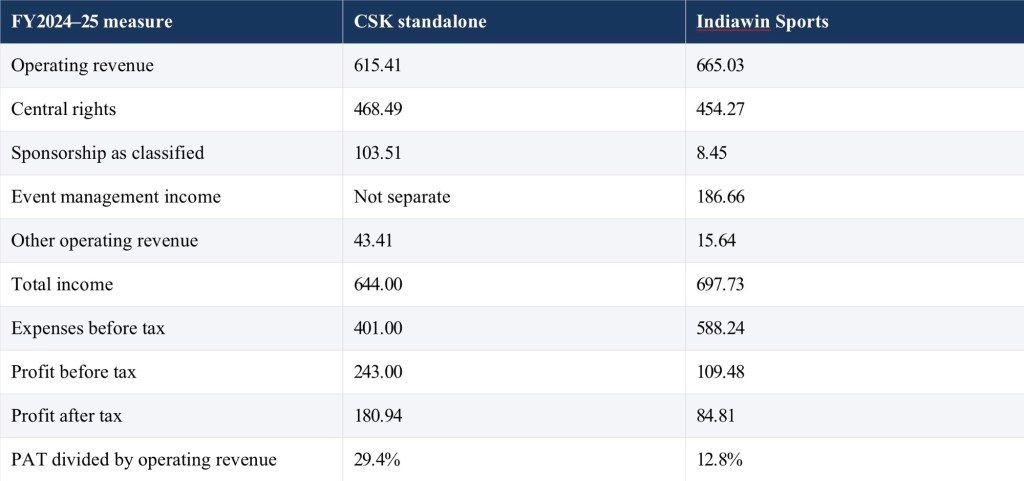
Team Economics of CSK and Mumbai Indians for a year

Sources: audited CSK and Indiawin FY2024–25 accounts. Ratios are author calculations. Indiawin’s event-management category cannot be recast as ticket sales or sponsorship without additional disclosure. Neither column is presented as a complete IPL 2026 season statement. [9,10]


In CSK’s standalone account, central rights supply 76.1% of operating revenue. Player and support-staff remuneration is Rs 127.72 crore, while the franchise fee is Rs 146.10 crore. Those figures show that player auctions are only one part of the cost structure. CSK consolidated operating revenue of Rs 673.80 crore and PAT of Rs 148.32 crore include additional businesses and must not be substituted for the standalone results. [9]


RCB provides a further historical comparison: financial reporting places FY25 operating revenue at about Rs 504 crore and PAT at about Rs 140 crore. The earlier Rs 21 crore profit figure conflicts with stronger reporting and is excluded. A 2026 media estimate of more than Rs 400 crore operating profit is not treated as audited evidence. [11]
Indicative ownership values of all ten teams

Valuation of IPL Teams


An ownership value is a stock of wealth representing expected future benefits, whereas season revenue is a flow. The two must be presented separately. The official March 2026 announcement records Rs 16,660 crore as consideration for 100% of Royal Challengers Sports Private Limited, including both IPL and WPL rights. It is an equity transaction benchmark, not an IPL-only enterprise value. The announcement was subject to closing conditions; it is not used here as proof of completion. [6]


To answer the question of what all ten teams might be worth on a somewhat similar basis, we use a transparent comparable-price illustration. Houlihan Lokey’s 2026 franchise brand values, reproduced by NDTV Profit, provide relative weights. These brand figures are not ownership prices. The conversion assumes that each franchise could command the same ownership-price-to-brand-value relationship as the RCB package. This is our modelling assumption, not Houlihan Lokey’s valuation method or a professional fair-value opinion. [15]


Formula: indicative price for team i = Rs 16,660 crore × team i brand value ÷ RCB brand value of US$312 million. Dollar amounts cancel in the ratio, so no exchange-rate assumption is needed. The resulting column is a package-equivalent comparison before correcting for RCB’s WPL component and differences in debt, cash, company scope or control rights. A second column assumes, solely for sensitivity analysis, that WPL accounts for 5% of the RCB package. It multiplies every estimate by 95% and is an IPL-only equity proxy, not an observed allocation.
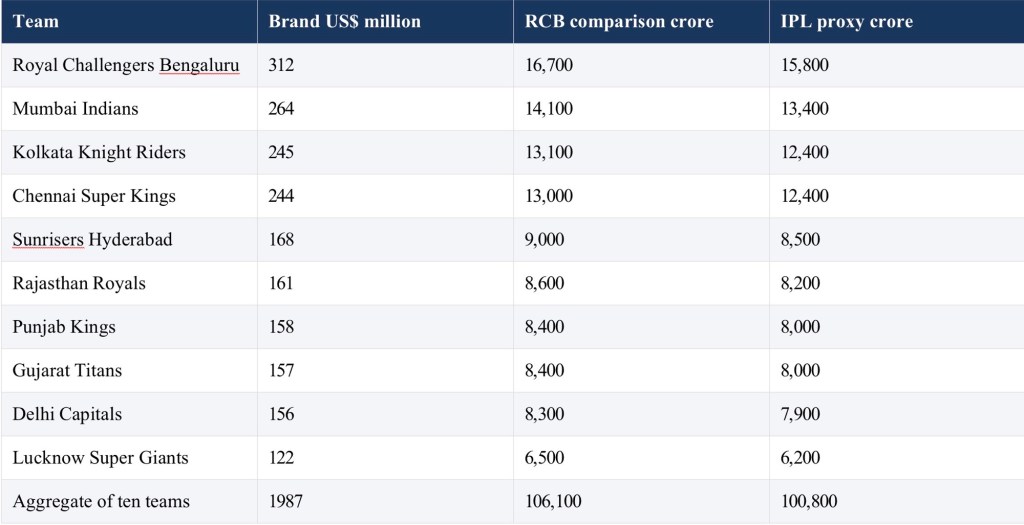
Valuation of IPL teams

The ownership columns are author calculations rounded to the nearest Rs 100 crore. Aggregate values are calculated before rounding, so displayed team figures may not sum exactly. The brand column is the reported 2026 external input; the two ownership columns are hypothetical results. RCB’s Rs 16,700 crore display is the rounded Rs 16,660 crore transaction benchmark, not a new valuation. [6,15]
The package-equivalent aggregate is approximately Rs 106,100 crore, or Rs 1.06 lakh crore. Assuming a 5% WPL allocation gives an IPL-only proxy of approximately Rs 100,800 crore. The top three in this particular comparison are RCB, Mumbai and Kolkata; their combined package-equivalent value is approximately Rs 43,800 crore. This ranking differs from the earlier revenue ranking because the measures differ.


If the undisclosed WPL allocation is assumed to be anywhere from 0% to 10%, the aggregate IPL proxy spans approximately Rs 95,500 to Rs 106,100 crore. This interval tests only that one assumption; it is not a confidence interval or a market valuation range. Changing the RCB price anchor to the user’s rounded Rs 16,000 crore reduces the unadjusted aggregate to approximately Rs 101,900 crore.


A revenue-multiple comparison gives a useful warning. Dividing RCB’s Rs 16,660 crore package price by its approximately Rs 504 crore FY25 operating revenue produces 33.06 times revenue. Applying that mechanically to the appendix’s provisional Rs 6,065.83 crore company-revenue sum produces approximately Rs 200,509 crore. This much larger result is not adopted: it mixes reporting dates and business scopes, and assumes that higher revenue always deserves the same multiple. The revenue inputs are already provisional. It demonstrates how strongly the chosen method affects the answer, rather than independently validating either total.


There is also evidence that the simple brand ratio misses real transaction factors. Reporting on the 2026 valuation study describes a Rajasthan Royals transaction at US$1.65 billion, versus US$1.78 billion for RCB. That price ratio is approximately 92.7%, while the reported RR-to-RCB brand-value ratio is only 51.6%. The transaction scopes must be reconciled before comparison, but this discrepancy alone prevents treating the brand-ratio results as reliable fair values. We retain the calculation as the requested comparable illustration and explicitly decline to call it a validated ownership valuation. [16]


A defensible valuation would forecast each IPL-only business’s cash flows, including central distributions, ticket receipts, sponsorship, genuinely incremental local stadium advertising, franchise fees and player costs. It would examine the next media-rights cycle, reinvestment needs, taxes, net debt and cash, contract duration and transfer conditions. Comparable transactions would then cross-check the discounted-cash-flow result. Losses in a single year do not automatically make a franchise worthless, and a brand valuation should not be added to the resulting ownership value.


For the essay’s magnitude argument, the appropriate presentation is therefore two separate lines: recurring seasonal commercial receipts measured in many thousands of crores, and an explicitly modelled stock of team ownership value of roughly Rs 1 lakh crore on an RCB-anchored comparison. The ownership aggregate is neither annual turnover nor a consolidated valuation of BCCI and IPL. It must not be added to season revenue, to the league enterprise valuation, or to the brand values.


Players broadcasters and the wider economy


The official regulations set the 2026 total salary cap at Rs 151 crore per franchise, including auction purse, incremental performance pay and match fees. Across ten teams that is Rs 1,510 crore of aggregate permitted player compensation, not verified actual expenditure. Match fees of Rs 7.5 lakh per playing member, including the impact player, sit within this total cap and should not be added to it again. Coaches and support staff require separate accounting. [12]


The broadcaster has a different challenge. Its rights purchase must be supported by advertising, subscriptions and wider platform benefits, after production and distribution costs. Strong franchise profits do not establish broadcaster profitability. Nor does a sponsorship purchase establish that an advertiser earned a return; that requires evidence on sales, customer acquisition or brand outcomes.


Hotels, airlines, taxis, caterers, security staff, production crews and small vendors share in the activity around matches. These transactions matter, but adding every payment would inflate economic contribution. Teams’ hotel bills already sit in expenses. Visitor spending can displace other spending in the same city. A credible economic-impact calculation measures additional value added, adjusts for imports and displacement, and separates temporary jobs from continuing employment. This study therefore does not invent a GDP contribution, tax total or employment multiplier.


What the magnitude means


The evidence supports a substantial conclusion. IPL’s media and title-sponsorship contracts alone imply an annual average above Rs 10,000 crore. Gate collections can reach hundreds of crores under explicit paid-attendance scenarios. Sponsorship monetises both the team identity and the stadium experience. Player compensation operates within a league-wide framework of roughly Rs 1,500 crore in permitted spending for 2026. Ownership values capitalise expectations about future earnings, explaining why they are much larger than one season’s revenue.


The commercial strength comes from organising audience attention into scarce, repeatable rights. Central selling provides a large shared income base, while franchises develop their own brands and match experiences. Its financial vulnerability is dependence on future rights prices and the broadcasters’ ability to recover those prices. Its growth opportunity is to earn more from fans through better access, hospitality, merchandise and sustained engagement without counting the same receipt twice.


My assessment is that IPL is an important Indian sports and entertainment business with recurring receipts measured in many thousands of crores. For the latest season, the responsible headline is an annualised core contract benchmark of Rs 10,178 crore, alongside a separately labelled reported revenue projection above US$1.8 billion. An exact audited consolidated 2026 total is not established. That distinction preserves the strength of the argument: the magnitude is remarkable even after the accounting is made honest.

Appendix on validation of the ten team comparison


These are FY2024–25 reported operating revenues, mostly rounded, not IPL 2026 figures. Parentheses indicate losses. S means checked against an audited company report; R means financial-media reporting; P means provisional secondary comparison requiring filing verification. Mixed company scopes prevent a validated IPL-only aggregate. [9–11,13,14]

The provisional revenue sum is Rs 6,065.83 crore using the displayed inputs, or approximately Rs 6,066 crore. The earlier Rs 650.81 crore nine-company PAT subtotal used CSK profit rounded to Rs 148 crore. Using Rs 148.32 crore gives Rs 651.13 crore. Neither subtotal is validated league profit. KKR, CSK and Mumbai reported operating revenues sum to Rs 2,094.83 crore, or 34.5% of the provisional sum. Their mixed business scopes make this a company-scale comparison only.


A further source discrepancy concerns BCCI concessionaire receipts. The official indexed Schedule 8 shows Rs 0.53 crore; a secondary dataset displays Rs 10.53 crore. This report follows the official schedule, which reconciles to its stated total. An annualised media-rights average must not be substituted for the historical recognised Rs 8,744.24 crore. The 2026 season’s precise revenue requires season-matched accounts.


Sources and calculation basis:


[1] BCCI official media rights award for 2023–2027. https://www.bcci.tv/news/article/bcci-announces-the-successful-bidders-for-acquiring-the-media-rights-for-the-indian-premier-league-seasons-2023-2027


[2] IPL official Tata title sponsorship for 2024–2028. https://www.iplt20.com/news/article/tata-group-secures-title-sponsorship-rights-for-ipl-2024-28


[3] Houlihan Lokey official 2026 valuation announcement. https://hl.com/about-us/newsroom/ipl-reaches-us-206-billion-valuation-amid-record-franchise-deals/


[4] Variety coverage of the 2026 study via Yahoo Finance. https://finance.yahoo.com/media-advertising/articles/royal-challengers-bengaluru-rajasthan-royals-070000915.html


[5] IPL official 2026 playoff schedule and ticket announcement. https://www.iplt20.com/news/article/tata-ipl-2026-playoffs-tickets-to-go-live-from-may-20


[6] Diageo announcement of agreement to sell RCSPL. https://www.diageo.com/en/news-and-media/press-releases/2026/diageo-subsidiary-united-spirits-limited-announces-full-divesture-of-its-stake-in-royal-challengers-sports-pvt-ltd


[7] BCCI audited FY2024–25 accounts Schedule 8 and Note 21. https://documents.bcci.tv/bcci/documents/1767792705346_Audited-BCCI-Financials-2024-25.pdf


[8] IPL official expressions of interest for partner rights. https://www.iplt20.com/news/article/expressions-of-interest-for-ipl-partner-rights


[9] CSK annual report FY2024–25 statements and Notes 25–27. https://gallery.chennaisuperkings.com/PROD/INVESTOR_CORNER/DOCUMENT/INVESTOR_CORNER_1756730556104_570e54_1756730556104.pdf


[10] Indiawin Sports audited financial statements FY2024–25. https://www.ril.com/sites/default/files/2025-07/Indiawin_Sports_Private_Limited.pdf


[11] Economic Times reporting on MI RCB and LSG FY25 accounts. https://economictimes.indiatimes.com/industry/media/entertainment/media/ipl-franchises-mi-rcb-lsg-earnings-take-a-hit/articleshow/123350917.cms


[12] IPL official player regulations for 2025–2027. https://www.iplt20.com/news/article/ipl-governing-council-announces-tata-ipl-player-regulations-2025-27


[13] Technosports ten-team reported revenue comparison. https://technosports.co.in/ipl-franchises-revenue-indian-premier-league/?amp=1


[14] Provisional FY25 profit comparison with DC and Punjab figures. https://www.linkedin.com/posts/sunil-gurjar-cfte-6abbb6134_ipl-ipl2025-cricketbusiness-activity-7450410484090146816-U6sA


[15] NDTV Profit reporting of all ten 2026 Houlihan Lokey franchise brand values. https://www.ndtvprofit.com/sports/cricket-indian-premier-league-ipl-crosses-usd-20-billion-valuation-for-first-time-check-financial-ranking-of-all-10-franchises-11838164/


[16] Reuters reporting of RCB and Rajasthan ownership transactions in the 2026 valuation study. https://www.reuters.com/world/india/ipls-business-value-soars-above-20-billion-says-report-2026-07-29/
BCCI values were checked against search-indexed official schedule extracts because direct retrieval returned an access error. CSK and Indiawin PDF text was directly accessible. The full 2026 Houlihan Lokey PDF exceeded retrieval limits; its official valuation announcement and attributed media coverage were used instead. Local advertising and gate scenarios are author calculations, not source-reported actuals. No unsupported scenario is included in an audited total.
Are we willing to listen to the person Kept Outside?

Are We Willing to Listen to the Person Kept Outside?

By CA.S. Muralidharan, Business Mentor and Thought Leader

A hymn is sung inside a temple. A teacher explains its meaning. Outside stands a devotee who believes in the same God but is forbidden to enter.

For centuries, that distance could be defended as part of a sacred social order. The person outside might have heard the chant, but could not always learn it, explain it or cross the threshold. To understand this history, we must listen to those who preserved India’s religious traditions. We must listen just as carefully to those denied a place within them.

Today, the question has acquired another urgency. India aspires to become Viksit Bharat by 2047. What would “developed” mean if a child’s birth still affects whose ability is recognised, whose enterprise receives support, or whose voice is heard when decisions are made?

How did the gate come to be closed?

The Vedas are four ancient collections: the Rigveda, Samaveda, Yajurveda and Atharvaveda. They contain hymns, chants, ritual formulas and reflections on life and the universe. They took shape across generations and were preserved through exacting oral instruction. Traditional belief holds that the rishis heard sacred knowledge; historical study examines the poets and schools that composed, collected and transmitted it. (vedicheritage.gov.in, vedicheritage.gov.in, ich.unesco.org)

Learning to recite the Vedas accurately demanded years of discipline. But over time, the question of how to preserve the tradition became bound to the question of who was entitled to learn it. Later rules linked formal Vedic study to upanayana, an initiation prescribed for boys of the Brahmin, Kshatriya and Vaishya varnas. Shudras were excluded from that prescribed route, while women’s access was restricted in many later traditions. The rules did not reserve all Vedic learning for Brahmins alone. They were nevertheless unequal. (sacred-texts.com, sacred-texts.com)

The Purusha Sukta in the Rigveda names four varnas through the image of a cosmic person. It does not prescribe every later restriction on education, work or social contact. Subsequent texts went further. Passages of the Manusmriti, for instance, assigned Shudras subordinate duties and placed certain other communities outside village life. Such prescriptions were not a single law code enforced uniformly across India. Yet they could give religious authority to inherited inequality. (sacred-texts.com, sacred-texts.com, sacred-texts.com)

A boundary around specialised learning had become something much larger: a judgment about human standing.

At Vaikom in Kerala, oppressed communities had to campaign in the 1920s for the right to use roads near a temple. Caste and economic pressure also bound some communities to handling human waste, while the society that demanded this labour treated its workers as impure. The injustice reached the road, the well, the school, the workplace and the home. (kottayam.gov.in, hrw.org)

We cannot dismiss these practices as a harmless division of labour that somehow went astray. Religious claims, inherited occupation, land and local power reinforced one another. Nor was every instance a simple encounter between a Brahmin and a non-Brahmin. Locally dominant non-Brahmin castes could also enforce exclusion against Dalit communities.

Those who challenged it from within

The tradition also contains voices that questioned the closed gate. In the Chandogya Upanishad, Satyakama Jabala cannot identify his paternal lineage. He speaks truthfully to a prospective teacher, who accepts him. The story cannot prove that ancient education was open to everyone. It does, however, ask whether truthfulness and spiritual aspiration matter more than descent. (wisdomlib.org)

Centuries later, Ramanuja gave that question enduring force within Sri Vaishnavism. Building on the Tamil Alvars’ devotional hymns, he taught a path centred on Narayana’s grace, devotion and surrender. Spiritual teaching in Tamil could reach people who had no access to formal Vedic Sanskrit study. (iep.utm.edu, academic.oup.com)

A celebrated account says that Ramanuja publicly shared a sacred mantra he had been told to guard, accepting the consequences if others could benefit. Traditions also remember his respect for Dhanurdasa, a devotee of lower social standing, and associate him with wider participation in worship at Melkote. These stories come largely from later devotional biographies; we cannot independently verify every detail. Their challenge remains clear: if God’s grace is available to every soul, who has the right to keep the way to God for a few? (cambridge.org, hindupedia.com, academic.oup.com)

Ramanuja did not abolish every traditional distinction concerning Vedic study. His reform lay especially in the place he gave devotion, surrender and Tamil teaching. Others challenged inherited rank in different ways. Basavanna and the Sharanas honoured work and contested caste boundaries. Chokhamela expressed both devotion to Vitthal and the pain of exclusion. Ravidas imagined a society free of inherited humiliation. Sri Narayana Guru consecrated a Shiva shrine at Aruvippuram despite conventions reserving such authority for Brahmins. (academic.oup.com, en.wikisource.org, books.google.com, keralatourism.org)

Each raised a deeper question. May everyone pray? May everyone enter? May everyone teach and lead? Can everyone live and work without birth deciding their worth?

When people sought another path

Some people concluded that reform from within would never give them the dignity they sought. Religious conversion became, for some, an act of faith and an assertion of freedom.

The clearest example is B. R. Ambedkar. Having experienced caste discrimination and argued for years against the authority behind it, he embraced Buddhism with many followers at Nagpur in 1956. This was more than a private change of belief. It was a public refusal to accept an identity assigned an inferior place, and the building of a new religious community around dignity. (ambedkarfoundation.nic.in, academic.oup.com)

Other Dalit communities embraced Christianity. Their histories include faith, education, community organisation and the hope of escaping degrading social relations. The reasons varied by place and period; a conversion cannot be reduced to one motive. Historians also record conversions to Sikhism and Islam among communities seeking different religious and social possibilities. Sikh teachings rejected caste distinctions, although caste shaped some later social practice among Sikhs. (academic.oup.com, academic.oup.com, cambridge.org)

We must be especially careful with a sweeping claim that lower-caste Hindus converted to Islam en masse solely to escape caste. Historian Richard Eaton’s work on Bengal and Punjab challenges that explanation for those regions, placing religious change within longer histories of settlement, agriculture and local religious communities. Caste oppression was a motive in some people’s choices; it cannot explain every Muslim community’s origins. (experts.arizona.edu, experts.arizona.edu)

Nor did changing religion always remove caste from social life. Caste identities and discrimination can persist among Indian Christians, Muslims and Sikhs despite the egalitarian teachings many find in those faiths. Conversion could offer spiritual self-respect, solidarity and new opportunity without automatically dissolving the inequalities surrounding a family. (academic.oup.com, pewresearch.org, academic.oup.com)

This makes conversion a serious message to the society a person left. It says, in effect: I sought dignity here and could not find enough of it. We should hear that message without questioning anyone’s freedom to believe differently. The purpose of confronting caste is equal dignity for every person, whether they remain Hindu, adopt another faith or profess none.

Conversion has also not fundamentally changed India’s overall religious composition in recent decades. Pew Research Center’s survey found that about 98% of Indian adults identified with the religion in which they were raised. The significance of Ambedkar’s conversion cannot be measured only by its effect on population shares. (pewresearch.org)

The unfinished work of reform

India is not alone in confronting inherited exclusion. The United States ended slavery and legal segregation, yet Black families continue to face large economic gaps. South Africa ended apartheid and held an election open to all races in 1994, yet the distribution of income still bears the marks of that history. Japan abolished the old inferior legal status of Buraku communities in 1871, but later needed further measures against continuing prejudice. These systems differ profoundly in origin and operation. They share one lesson: a law can open a gate long before the effects of exclusion disappear. (federalreserve.gov, gov.za, statssa.gov.za, japaneselawtranslation.go.jp)

India has made real progress. Untouchability is prohibited, and research finds convergence in education and occupations between upper castes and Scheduled Castes and Tribes since the 1980s. Affirmative action has helped targeted students enter higher education, including better-quality engineering colleges in one major study. These gains matter. (constitutionofindia.net, warwick.ac.uk, swlb1.aeaweb.org)

But the economic cost of remaining barriers also matters. An August 2026 working paper models the higher entry costs and tighter finance faced by entrepreneurs from historically disadvantaged castes. It estimates that these barriers reduce output by 6%. That is a modelled estimate of particular barriers, not a measure of every loss caused by caste throughout India’s history. It does, however, show what may happen when capable founders cannot obtain the same chance to start and grow a business. (bse.eu)

The cost begins earlier. In an experiment in India, teachers gave slightly lower marks to otherwise identical examination papers when the papers were assigned a lower-caste identity. If a child’s work is judged through a social label, opportunity is diminished before the labour market even begins. (benny.aeaweb.org)

What would Viksit Bharat require?

A developed India needs roads, schools, technology, investment and productive enterprises. It also needs every person’s ability to be recognised and used. The Viksit Bharat vision itself speaks of inclusive development and empowering citizens to realise their aspirations. Taking that promise seriously means asking who still cannot make use of the opportunities that already exist. (niti.gov.in, niti.gov.in)

Listening to the person kept outside must therefore be more than an expression of sympathy. It means hearing students about treatment in classrooms; workers about hiring and safety; entrepreneurs about credit, customers and networks; and families about access to housing, public services and justice. It means allowing those affected to help shape the institutions that serve them, and checking whether outcomes improve.

If a talented child is underestimated, India loses part of its future skill. If an able founder cannot obtain finance because of inherited disadvantage, India loses a possible enterprise. If a citizen cannot trust a school, workplace or public office to treat them fairly, India loses something still harder to measure: confidence that the country belongs equally to all.

Gandhi fought untouchability while seeking reform within Hindu society. Ambedkar argued that its cruelties could not be fully ended while inherited hierarchy retained its authority. His decision to embrace Buddhism made clear how high the stakes were. A person may cease asking to be admitted through a gate whose keepers continue to question their worth. (ccnmtl.columbia.edu, ccnmtl.columbia.edu, ambedkarfoundation.nic.in)

By 2047, India may be far wealthier. But wealth alone cannot tell us whether it has become developed in the fullest sense. We must ask whether birth still narrows a child’s future, whether dignity depends on social rank, and whether the people most affected have a voice in changing the system.

The person kept outside was never silent. They prayed, wrote, worked, organised, converted, challenged and built new institutions. The question is whether we are willing to hear what they have been saying—and share the power to act on it.

How Religions and worship changed in India

The Gods We Inherited, the Gods We Met

How India’s religious traditions grew through encounter, argument and change

By CA. S. Muralidharan, Business Mentor and Thought-Leader

At the entrance to a Tamil village stands a small shrine. Its guardian deity has a name known to every family nearby. Once a year, the village gathers for a festival that belongs to this place and no other.

A few kilometres away is a large Shiva temple. The same family may pray there too.

Which is their religion?

Today we might answer, “Hinduism.” That answer is understandable. But if we want to know how these forms of worship came together, the question becomes more interesting. Did the village deity always belong to the same religious world as Shiva? Did the two traditions meet gradually? Did someone decide that one form of worship was more respectable than the other?

India’s religious history is full of questions like these. It is a history of people carrying beliefs across borders, arguing over how to live, and finding new meanings in practices they inherited.

What did people believe before there was one umbrella?

We often speak of Hinduism as though it had always been one religion with a settled list of gods and a common set of rules. Ancient India was much less tidy.

People belonged to particular places and communities. Some followed teachers devoted to Shiva or Vishnu. Others worshipped goddesses, ancestors or guardians of a village. These traditions could overlap in a person’s life without being governed by one institution.

The broad name Hinduism became much more clearly defined in later centuries, especially during the colonial period. That does not mean the British created its older traditions. It means that a modern label brought many living traditions together under one heading. The word Hindu itself has a longer, changing history, which historians continue to study and debate. (cambridge.org, cambridge.org)

That distinction helps us see the past more clearly. A king’s gift to a Shiva temple tells us about that king, that temple and its community. It does not automatically tell us what every village in his kingdom believed.

The world of the Vedas

The oldest Vedic hymns bring us into a different setting. We hear praise of Agni, Indra, Varuna, Soma and solar deities. Fire and the sun are part of this world, as are rain, power and cosmic order. Calling it “nature worship” captures something real, but only part of it. The hymns also ask what human beings can seek from the gods and what offerings mean. (academic.oup.com, academic.oup.com)

These hymns were composed in Vedic Sanskrit, the oldest form of Sanskrit known to us. The language had a history before those hymns and continued to change afterwards. Evidence from languages and ancient DNA supports movement of Indo-Aryan-speaking groups into northwestern South Asia, followed by mixing and interaction with people already living there. It does not give us a scene in which one people arrived on one day and replaced everyone else. (cambridge.org, science.org, sciencedirect.com)

What did the people already living in the region worship? We know less than we would like. The Indus civilisation left objects and images, but its script has not been deciphered. A figure on a seal is sometimes called an early Shiva; that identification remains disputed. We should be curious about possible continuities without treating guesses as established history. (britishmuseum.org, cambridge.org)

There is another surprise here. The Shiva and Vishnu who became central to later temple worship were not already the central gods of the Rigveda. Rudra appears in the text and is connected to the later history of Shiva. Vishnu appears too, but his prominence grew greatly in subsequent centuries. The traditions we know today had long histories of development within India. (academic.oup.com, academic.oup.com, academic.oup.com)

An argument about killing

Some Vedic rituals involved animal sacrifice. People also ate meat, although the texts do not show one rule followed by everyone.

One passage in the Śatapatha Brāhmaṇa makes the disagreement unusually vivid. It advises against eating the flesh of a cow or ox. Then it records the sage Yājñavalkya saying that he would eat it if it were tender. We do not need to make either view stand for an entire age. The passage matters because both views appear in the same tradition. (wisdomlib.org, wisdomlib.org)

Imagine watching an animal led to a sacrifice and asking: Can killing truly be a path to spiritual good?

Jain and Buddhist teachers gave that question great force. Jainism placed extraordinary emphasis on avoiding harm to living beings. Its Ācārāṅga Sūtra objects to killing for sacrifice as well as for other human purposes. Early Buddhist teaching also criticised animal killing in sacrifice. Yet the earliest Buddhist rules did not require every monk to refuse all meat. Their concern included whether an animal had been killed specifically to feed the monk. (en.wikisource.org, suttacentral.net, suttacentral.net)

Sacrifice was an important disagreement. It was not the only reason Buddhism and Jainism emerged. Their teachers also asked deeper questions: What causes suffering? What binds a person to repeated birth? Is performing a ritual enough? What kind of life leads to freedom? They were part of a wider period of searching and debate, in which other Indian traditions were changing too. (cambridge.org, cambridge.org)

What happened to the village gods?

The great texts tell only part of the story. For many people, the nearest sacred place was not a famous centre of learning. It was the shrine at the edge of a field or at the entrance to a village.

A guardian deity might have a festival, a story and a priestly family particular to that community. People could worship that deity while also visiting a Shiva or Vishnu temple. Over time, a local goddess might be associated with a wider Goddess tradition. A shrine might acquire new patrons or new rituals. In other places, older forms of worship carried on. Research in one Tamil village, for instance, found guardian-deity practices that had not simply been replaced by non-sacrificial temple rites. (cambridge.org)

Sometimes we call such change Sanskritisation or Brahmanisation. But those words should lead to questions, not close them. Did local people want a new form of worship? Did a ruler fund the shrine? Did a Brahmin priest gain a role? What happened to the family that had cared for the deity before?

The answer may differ from one village to the next. Religious change happened through people with unequal power, but local communities were never absent from their own history.

Faiths could compete—and still survive

It would also be a mistake to imagine that all traditions now called Hindu always acted together. Shaiva and Vaishnava communities could disagree sharply. At Chidambaram, a 12th-century Chola court poem associates King Kulottunga II with removing an image of Vishnu from a temple complex centred on Shiva. The accounts disagree on the image’s fate. Even with that uncertainty, the episode shows why we should not erase older sectarian loyalties beneath a modern umbrella name. (journals.sagepub.com, ignca.gov.in)

Buddhists and Jains also faced changing fortunes in South India as Shaiva and Vaishnava temples gained prominence. Some later stories describe religious contests in dramatic, even violent terms. We need to read such stories carefully: they show how communities remembered their rivals, but their most sweeping claims are not automatically confirmed by contemporary records.

The material evidence tells us something equally important: decline was not the same as sudden disappearance. Jain communities survived. Buddhism remained present at particular sites long after it became less prominent elsewhere. Around 1006 CE, for example, a Buddhist monastery at Nagapattinam received support through a grant associated with the Chola ruler Rajaraja I. (govtmuseumchennai.org, metmuseum.org, ignca.gov.in)

A ruler could be deeply devoted to one tradition and still support an institution of another. History rarely gives us the simple divisions we expect.

Why did Buddhism travel so far?

Buddhism began in India, yet it became deeply rooted across Asia. Teachers travelled. Merchants supported monasteries near routes of trade. Rulers sometimes offered protection and resources. Monasteries trained new generations and preserved texts that could be translated into other languages. (metmuseum.org, academic.oup.com, cambridge.org)

The people who received Buddhism did more than preserve an Indian teaching. Communities in Sri Lanka, Southeast Asia, China, Tibet, Korea and Japan interpreted it through their own languages and lives. That helps explain its endurance abroad.

Its position in India changed for several reasons over a long period. Patronage shifted; monastic institutions contracted in many regions; and later upheavals damaged important centres. Yet eastern Indian monasteries still flourished for centuries after Buddhism had weakened elsewhere. There was no single date on which “India lost Buddhism.” (academic.oup.com, cambridge.org, academic.oup.com)

Jainism’s history offers a different kind of endurance. It did not become a majority religion in other Asian countries. Its monks, nuns, families and donors sustained it chiefly within India, where it remains a living faith.

The contrast is visible today. India’s 2011 census counted about 8.4 million Buddhists and 4.5 million Jains. Pew estimated about 10 million Buddhists in India in 2020, still less than one per cent of its population. By Pew’s 2020 estimates, Buddhists formed 94% of Thailand’s population, 97% of Cambodia’s, 89% of Myanmar’s and 70% of Sri Lanka’s. These are counts of religious identity, not a measure of everyone influenced by Buddhist thought. (pewresearch.org, pewresearch.org, pewresearch.org)

Jainism remained strongest where it began. Buddhism became a major faith far beyond its birthplace.

A familiar pattern, but not necessarily a borrowed one

Buddhism’s travels invite comparison with Christianity. Both reached distant communities through teachers, relationships, travel and translation. Both gained the support of rulers at certain moments. In both, believers built institutions that outlasted the travellers who began them.

Does that mean Christianity learned its original missionary method from Buddhism? We do not have evidence to make that claim. Early Christian missions grew in a Jewish and Greco-Roman world. Their surviving records tell us about Jesus’ followers, Paul and the communities they reached. Much later, Christian missionaries in Asia did respond to Buddhist institutions: Jesuits in 16th-century China initially adopted an appearance resembling Buddhist monks. That is evidence of a particular encounter, not proof that one religion’s entire method was copied from the other. (academic.oup.com, cambridge.org)

The comparison is still worth making. It helps us ask how a teaching travels, what makes a community sustain it, and how much it changes when it reaches a new home.

The question behind the history

None of these traditions lived in isolation. Vedic ritual changed. Village worship persisted and adapted. Jain and Buddhist teachers challenged practices they believed caused harm. Shaiva and Vaishnava communities built great temples and sometimes disputed one another’s place. Buddhism travelled abroad; Jainism kept its roots in India.

Calling this simply a story of one religion replacing another misses the people who lived through it.

The family at the village shrine may never have asked whether their guardian deity belonged inside a historian’s category. They knew who had protected their village, who conducted its festival and where their parents had taken them to pray. Their descendants could also visit a Shiva temple without forgetting any of that.

Perhaps the most revealing question in religious history is therefore not only “Where did this belief come from?” It is also:

Who kept it alive, who changed it, and what did it mean to the people who practised it?

India, an adaptive Civilisation: Invitation for a co-creative study

India and Adaptive Civilisational Continuity – An Ideation Paper for a Wider Civilisational Study


CA. S. Muralidharan
Business Mentor and Thought Leader
September 2026


The Starting Idea


India presents an unusual historical picture. Kings, dynasties, empires and governments changed repeatedly, but the civilisation did not disappear with them. The Mauryas, Guptas, Pallavas, Cholas, Rajputs and Marathas ruled different regions and periods. Delhi Sultanates and the Mughals brought new political and cultural influences. The East India Company and the British Crown transformed administration, law and education.

After Independence, Congress, the BJP and many regional parties governed different parts of the country. Yet through all these changes, ordinary people continued to transmit a recognisable set of stories, practices, duties, festivals, family relationships, sacred places and ideas about life.


This paper proposes a simple but important explanation:

India’s continuity was carried less by an uninterrupted state and more by society itself. Families, communities, teachers, temples, mathas, monasteries, shrines, pilgrims, poets, storytellers, artisans and regional literatures preserved civilisation even when political power changed hands.


The argument is not that India remained frozen in time or that every inherited practice was desirable. India changed continuously and sometimes painfully. The more accurate idea is adaptive civilisational continuity: India remained recognisably itself by absorbing, debating and reinterpreting change.


Central proposition.

India’s rulers repeatedly changed, but the deepest carriers of civilisation were distributed throughout society. This gave India resilience, pluralism and cultural depth. The same structure also preserved hierarchy, slowed reform and did not always produce strong civic institutions.


Invitation to contribute ideas, suggestions and points for this co-creative study:


Having laid out the framework of the study, I wish to invite from all possible sources your suggestions, ideas and thoughts on this subject. That will be very useful for me and you also, mutually, to continue with this study and share the understanding with all of you in future. I will thank every one of you for your contribution,however much, small or big,it might be. Now, please read on the expanded version of the central proposition of the study. Thank you.

How Could a Civilisation Survive So Much Change?


Most modern nations use the state to create a common identity through schools, law, official language, media and administration. Premodern India rarely had one government controlling the whole subcontinent for long periods. Nevertheless, people across regions recognised many of the same epics, sacred geographies, moral ideas and civilisational symbols. Political India was often divided, but civilisational India remained connected.


Several social mechanisms may explain this continuity.


The family as a carrier of civilisation


Language, prayer, food, festivals, respect for elders, family obligations and stories were learned at home. Such transmission did not require a central authority or even formal literacy. Political conquest could replace a king, but it could not easily enter every household and erase inherited memory.


Oral tradition and literature


India preserved knowledge through both disciplined recitation and creative retelling. The Vedas represent highly organised oral preservation. The Ramayana, Mahabharata, Puranic stories, Bhakti poetry and regional traditions reached people through performance, music and storytelling. Tamil, Sanskrit, Pali, Prakrit, Persian, Arabic and many vernacular languages created overlapping cultural worlds rather than one narrow channel of transmission.


Sacred geography and pilgrimage


Rivers, mountains, temples, shrines and places associated with saints and epics created a mental map larger than any kingdom. Pilgrimage carried ideas and practices across political boundaries. A ruler controlled a territory; sacred geography connected a civilisation.
Many paths rather than one central creed


Indian traditions disagreed deeply about God, ritual, knowledge, devotion, duty and liberation. Yet the existence of many schools and paths reduced dependence on a single religious authority. If one institution weakened, the larger cultural field could continue through others. This plurality did not guarantee equality or peace, but it made total control difficult.


Dharma above political power


A recurring Indian ideal was that the ruler did not create the entire moral order. He was expected to act within a larger framework of duty or rajadharma. This ideal was not always followed, but it placed political power within a moral universe rather than treating the ruler as the sole source of truth.

Continuity Did Not Mean an Unchanged India –


The theory becomes credible only when it openly recognises change.

a. Buddhism and Jainism challenged older practices.

b.Temple-centred traditions expanded.

c. Bhakti movements carried devotion into regional languages and sometimes questioned hierarchy.

d. Islam and Persianate culture transformed architecture, administration, language, music and social life.

e. Sikhism emerged as a major Indian tradition.

f. Christianity developed old and new communities.

g. Colonial rule introduced English education, railways, codified law, census categories and modern bureaucracy.

h. Constitutional democracy later introduced universal citizenship, fundamental rights and new standards of equality.


The encounters with Sultanate and Mughal rule must be examined without denial or exaggeration. There were conquest, violence, temple destruction, discriminatory policies and instances of coercion. There were also political alliances across religions, diverse officials in royal service, patronage, translation, Sufi and Bhakti interaction, artistic synthesis and the development of durable Indo-Islamic cultures. Different rulers and regions followed different policies.

The serious question is not whether India was untouched, but why extensive political change did not create complete civilisational replacement.


British rule was an even deeper institutional intervention. Colonial government did not merely observe Indian society; through law, censuses, education and official categories, it changed how caste, tribe, religion and property were understood. Some flexible identities became more rigid.

At the same time, Indians used print, English education, railways and modern political ideas to criticise colonialism and reinterpret their own civilisation. Gandhi, Ambedkar, Vivekananda, Tagore, Aurobindo, Nehru and others offered sharply different visions of what India should preserve and what it should reform.


Therefore, the continuity of India should not be described as an unchanged body and soul. A better image is a river: recognisable across distance, yet never made of exactly the same water. Civilisations continue by remembering, absorbing, rejecting and recreating.


A necessary caution


“Dharmic values” cannot be used only for whatever appears admirable. The inherited order also included caste exclusion, untouchability, restrictions on women, hereditary privilege and social conformity. Civilisational continuity can preserve injustice as effectively as it preserves wisdom. The proposed study must therefore ask not merely what survived, but whom it served, whom it excluded and what it prevented from changing.


Similarly, tolerance must be separated from integration. Communities may respect one another while living largely separate social lives. India’s historical strength may often have been coexistence without complete uniformity; whether that also produced equal citizenship is a different question.

India and the Western Experience


The original idea contrasts India with Western societies where the ruler’s religion sometimes became the religion of the territory. This has historical support in parts of Reformation Europe. The principle associated with the Peace of Augsburg allowed rulers within the Holy Roman Empire to determine the official confession of their territories. England also experienced rapid official religious changes under successive monarchs.


However, the contrast should not be overstated. European people did not simply change every belief whenever rulers changed. Churches, monasteries, universities, local traditions, dissenting communities and families also preserved continuity. Judaism survived centuries of persecution without political sovereignty. The West, too, had institutions outside the state.


The more useful comparison is about relative emphasis. India’s distributed social order made civilisation highly resilient, but sometimes fragmented. European state-building often imposed greater uniformity, but it later supported standardised law, universal schooling, public health, municipal systems and welfare institutions. China represents another pattern: strong civilisational continuity joined to a powerful bureaucratic state. Japan showed that rapid modernisation could occur without total cultural surrender.


Indian tendency Principal strength Possible weakness –


a. Family and community transmission Resilience and local ownership Hierarchy and exclusion
b. Plural sacred traditions Accommodation of difference Coexistence without integration
c. Civilisation larger than the state Survival through regime change Weak coordination and slow reform
d. Selective absorption Modernisation without total imitation Uneven institutional change


Who Deserves Credit for Modern India


No political party created India’s civilisational inheritance, and no government can claim ownership of it. Social values, family investment, enterprise, professional knowledge and community networks existed before any present party. But it would also be incorrect to say that governments deserve credit only for roads and civic amenities. Governments shape education, health, law, security, scientific institutions, economic opportunity, welfare and constitutional rights.


The better approach is co-production. Society supplies cultural memory, aspiration, enterprise and mutual support. The state supplies—or fails to supply—equal rights, public goods, coordination and institutional capacity. Governments deserve credit or blame for how effectively they convert India’s inherited social energy into broad public capability.
This leads to an important puzzle. India has world-class capability in areas such as space, pharmaceuticals, digital public infrastructure and electoral administration, yet many cities and villages struggle with sanitation, water, waste management, public health and municipal governance.

Could a culture historically strong in family and community responsibility be comparatively weaker in responsibility for impersonal public space? This is a hypothesis to be tested, not a conclusion to be assumed.

What the Proposed Study Should Investigate? –


The central research question is straightforward: How did Indian civilisation preserve a recognisable moral and cultural grammar through repeated changes of political authority, and what benefits and limitations followed from the social mechanisms that made this possible?


The study should examine six connected questions:-


Which practices show genuine continuity, and which were later reconstructions presented as ancient?


How did family, community, caste, temple, monastery, pilgrimage, language, literature, markets and rulers each contribute?


How did Islamic, Persianate, Christian and Western influences become challengers to, and eventually constituents of, Indian civilisation?


Did Indian pluralism produce tolerance, social separation, equal citizenship—or different combinations at different times?


Did strong family and community networks create resilience while weakening impersonal civic institutions?


What can India learn from the institutional strengths of the West, the state capacity of China and the adaptive modernisation of Japan without losing its own plural identity?


The research must compare like with like. India’s ideals should not be compared with Europe’s failures, nor European ideals with India’s failures. Royal policy must be distinguished from everyday practice. Philosophical texts must not be assumed to describe social reality. Each major chapter should deliberately examine evidence against the argument.


The Larger Idea


The preliminary hypothesis is that India historically moralised society more successfully than it institutionalised the state. China moralised and organised the state more strongly, but often allowed less social plurality.

The modern West created powerful impersonal institutions, but in recent decades has weakened some inherited sources of family, faith, meaning and cohesion. These are broad tendencies, not final verdicts. Their purpose is to identify what each civilisation developed well and what it may learn from others.


India’s future challenge is not to choose between tradition and modernity. It is to decide what must be preserved, what must be reformed and what must be transcended. Family responsibility, plural paths, cultural memory, intellectual debate and respect for a moral order larger than power remain valuable resources. Caste oppression, exclusion, gender inequality, social segregation and acceptance of poor public systems cannot be defended in the name of continuity.


Closing Thought


India’s greatest civilisational achievement may be neither conquest nor uniformity, but the ability to remain recognisably itself while absorbing profound change.

Its next achievement must be more demanding: to preserve meaning without preserving injustice, to cultivate unity without imposing uniformity, and to convert social resilience into high-quality institutions for every citizen. This is the idea the proposed study will test.

Can we work together to co-create this study? Thank you.

India and China: Civilisational Moorings, Divergent Paths, and 21st Century Resonance

India and China: Civilisational Moorings, Divergent Paths, and 21st Century Resonance


By CA. S. Muralidharan Business Mentor and Thought Leader
July 2026


Civilisations, unlike nations, are not born in a moment nor extinguished by conquest. They evolve over millennia, shaping the consciousness, institutions, and destinies of peoples. Among the world’s enduring civilisations, India and China stand out not only for their antiquity but also for their continuity — each a unique moral, philosophical, and political universe that has survived empire, invasion, and ideology. Yet their civilisational moorings and underpinnings, while equally deep, have led them down profoundly different paths in history and into the 21st century.


The story of their rise today — India as a pluralistic democracy and China as an authoritarian meritocracy — is not just a contest of political systems or economic performance. It is a civilisational divergence: a contrast between the Indian vision of moral pluralism and the Chinese vision of ordered unity.


Civilisational Foundations –


India: The Pluralistic Sacred Order


Indian civilisation rests on the concept of : –
Dharma — the moral, cosmic, and social order that sustains life. Unlike political or economic doctrines, dharma is not prescribed by the state; it arises from a moral consciousness shared across diverse sects, castes, and faiths. This has produced an enduring spiritual humanism, where the pursuit of truth (satya) is manifold and inclusive.


The Indian worldview regards the universe as an interconnected web of beings where harmony emerges through diversity. Hence, its society evolved not through uniformity but through accommodation — of ideas, languages, and faiths. From the Vedic hymns to Buddhist compassion, from Jain non-violence to Bhakti devotion, Indian thought celebrates multiplicity.


The state (rajya) in Indian tradition was never absolute. Power was legitimate only when aligned with dharma. Kings and rulers were judged not by conquest but by moral virtue — a principle that ensured both accountability and decentralisation. Local communities, guilds, and castes operated as self-regulating units, giving India a deeply rooted culture of plural governance.


China: The Hierarchical Secular Order


China’s civilisational foundation, by contrast, is Confucian and collectivist, centered on harmony through hierarchy. The universe is ordered under Tianxia — “All under Heaven” — with the Emperor as the Son of Heaven maintaining cosmic balance through moral authority. This worldview gave rise to the Mandate of Heaven, where the legitimacy of rulers derived from their capacity to preserve order and prosperity.


Confucian ethics emphasised Li (ritual, propriety) and Ren (benevolence), creating a social fabric bound by filial duty, respect for authority, and social harmony. The Chinese state evolved as the supreme moral and administrative institution, responsible not merely for law and order but for ensuring the moral cultivation of its people.
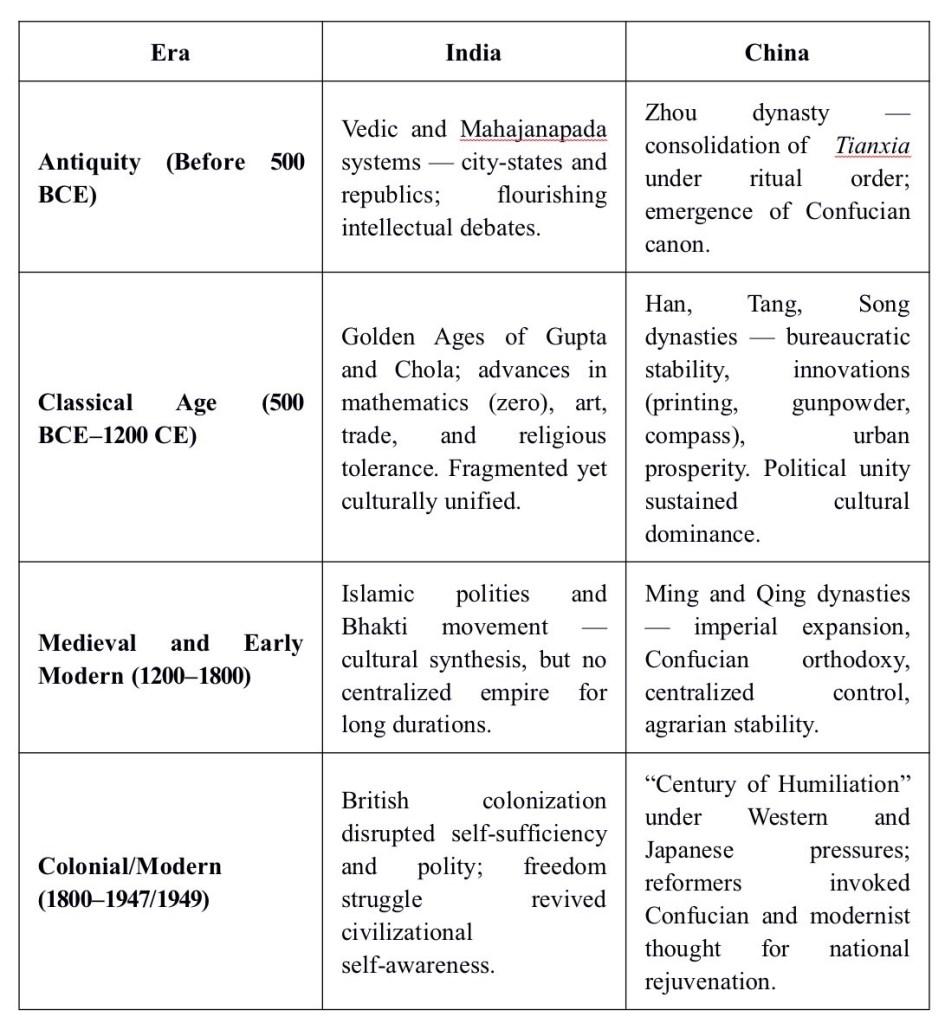
In short, India moralised society; China moralised the state. India decentralised power through communities; China centralised power through bureaucracy.

Historical Trajectories and Civilisational Effects of both civilisations:

The imprint of their philosophies is visible in how both civilisations evolved historically as above.


India: Unity in Cultural Diversity


Ancient India was not a monolithic empire but a civilisational continuum of kingdoms, republics, and empires united by shared moral and cultural codes. The Mauryan and Gupta periods produced remarkable achievements in governance, mathematics, medicine, and art, but even these empires governed within the framework of local autonomy and cultural pluralism.


Buddhism and Jainism challenged ritual orthodoxy, while Bhakti and Sufi movements later democratized spirituality, erasing boundaries between elite and folk religion. This continual renewal from within kept Indian civilisation resilient, though politically fragmented.
The arrival of Islam and later European colonialism tested this resilience. Yet, even under foreign rule, India absorbed external influences without losing its inner continuity. The freedom movement of the 19th and 20th centuries, led by figures like Vivekananda, Aurobindo, and Gandhi, was not merely political—it was a civilisational reawakening. Gandhi’s Swaraj was as much about reclaiming the moral autonomy of civilisation as it was about ending colonial rule.


China: Unity through Centralised Authority


In contrast, China’s genius lay in creating political unity out of diversity. From the Qin unification in 221 BCE to the Han, Tang, and Song dynasties, China maintained a centralised imperial structure governed by the Confucian bureaucracy. The civil service examination system — meritocratic and disciplined — ensured administrative continuity for over two millennia.


Chinese civilisation valued stability over speculation. While India’s sages debated metaphysics, China’s scholars codified law, agriculture, and administration. The Confucian order proved so enduring that even Buddhism, when it entered China, was “Sinicised” — turned into an instrument of social harmony rather than spiritual rebellion.
However, this unity came at a cost: innovation often yielded to orthodoxy, and dissent was seen as disorder. The same bureaucratic rigidity that once ensured stability later hindered adaptation, particularly during the encounters with Western powers in the 19th century.


Colonial and Modern Encounters


Both India and China entered the modern era weakened by internal stagnation and external aggression. Yet their responses were shaped by their civilisational DNA.


India’s colonisation under the British fractured its economy but rekindled its moral-spiritual core. Reformers from Raja Ram Mohan Roy to Vivekananda sought to reinterpret ancient values for modernity. The independence movement, though political in form, was civilisational in essence — affirming pluralism, moral self-rule, and resistance to material domination.


China’s experience — the “Century of Humiliation” — provoked a different reaction. From the Opium Wars to Japanese occupation, China’s response was to reclaim state strength. Thinkers like Sun Yat-sen and later Mao Zedong sought to restore the Mandate of Heaven through revolutionary unity. The Communist Party became the new moral custodian, replacing Confucian virtue with ideological purity but retaining the civilisational idea of a strong central authority ensuring harmony.


The 21st Century: Civilisational Modernities Reimagined –


Today, both nations are reasserting their ancient identities in modern forms. The 21st century is not merely witnessing an “Asian rise,” but the return of civilisations long suppressed under Western dominance.


China: The Technocratic Civilisation-State


Under the Communist Party, China presents itself as a civilisation-state — a polity that sees legitimacy not from liberal consent but from civilisational continuity and performance. The Confucian ideal of order has merged with the technocratic drive of modernity.
Beijing’s Belt and Road Initiative echoes Tianxia — a vision of interlinked economic and moral order led by China. The state’s role as moral guardian has re-emerged, now clothed in the language of “common prosperity” and “national rejuvenation.” Yet, this model’s strength — discipline, unity, and speed — also reveals its vulnerabilities: suppression of diversity, moral conformity, and limited space for individual freedom.


India: The Pluralist Civilization-Nation


India’s rise, by contrast, is anchored in its civilisational pluralism and democratic ethos. Its political debates, religious diversity, and linguistic multiplicity echo its ancient capacity for synthesis. The Constitution, secular yet spiritual in spirit, reflects the principle that truth and legitimacy are plural. India’s soft power — yoga, Ayurveda, spirituality, diaspora, and moral diplomacy — arises from its civilisational conviction that the world is one family (Vasudhaiva Kutumbakam). Its challenge, however, lies in translating moral and cultural pluralism into institutional coherence and social equity.


While China seeks harmony through uniformity, India seeks harmony through diversity. One is centripetal, the other centrifugal.

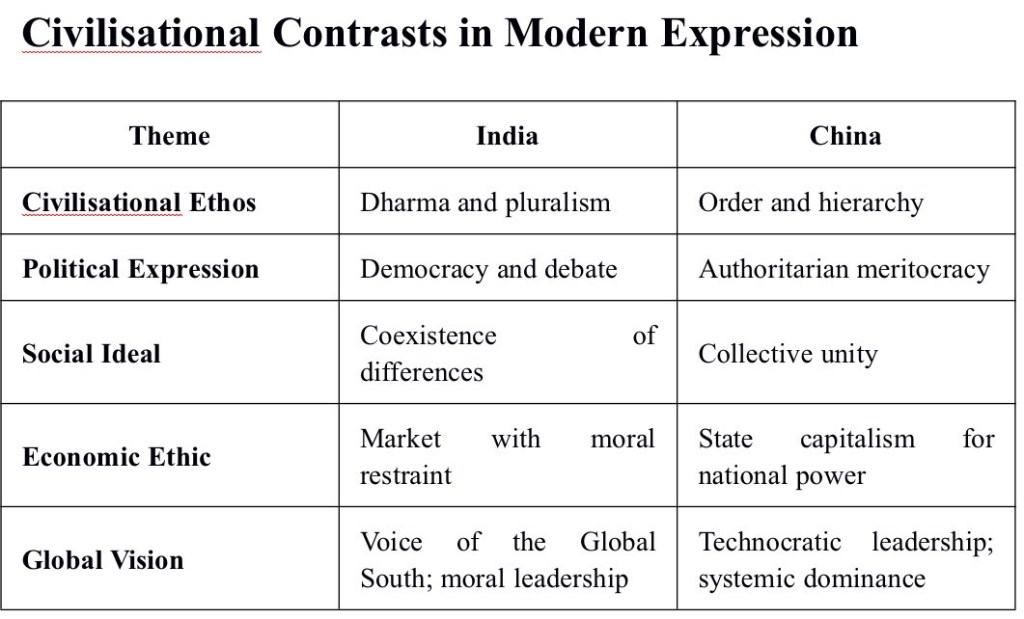
Civilisational Contrasts in Modern Expression:

These contrasts are not temporary or accidental; they are civilisationally encoded. India’s social complexity produces debate and gradualism; China’s unity produces focus and speed. India evolves through dialogue, China through direction.


Implications for the 21st Century World Order


As the Western world grapples with internal crises of meaning, identity, and trust, both India and China project civilisational alternatives. Yet their models appeal to different imaginations.


China’s model attracts those seeking efficiency without democracy — a system where order and prosperity trump freedom. India’s model attracts those who believe diversity and democracy can coexist with growth and stability.


The future global order may well reflect a dialogue between these two Asian civilisations, each reasserting its moral grammar: India’s ethics of multiplicity and China’s ethics of order. The challenge for humanity is not to choose between them but to ensure that power, wherever it resides, remains anchored in moral legitimacy rather than material triumph.


Conclusion


The rise of India and China today is not the rise of two nations but of two civilisational archetypes. India represents the civilisation of the soul — rooted in moral pluralism and inner freedom. China represents the civilisation of order — rooted in collective harmony and disciplined statecraft.


Their journeys have been shaped by opposite impulses: India’s diffusion versus China’s consolidation, India’s diversity versus China’s unity. Yet both have preserved continuity when many other civilisations faded.


In the 21st century, as the West’s ideological dominance wanes, the world turns again to Asia — not merely for markets or technology, but for meaning. India and China offer two contrasting paths to modernity: one democratic and spiritual, the other authoritarian and technocratic. Their interplay will define the moral and political architecture of the century to come.


India seeks to lead by dialogue; China by design.

One appeals to the conscience, the other to control.

Together, they remind the world that civilisation — not ideology — is destiny.


Without understanding these fundamental differences between the two great civilisations, we cannot understand their economic growth and development and the dynamics or the under-current of their development in the 21st Century and beyond.


We will continue to study that in the coming days.

INDIA 2047 – From Rising Economy to Comprehensive Global Power

INDIA 2047
From Rising Economy to Comprehensive Global Power


A Twenty-Year Strategy for Technology, Industry and Strategic Autonomy


Policy Paper for Government and Strategic Think Tanks – August 2026
(Prepared by CA. S.Muralidharan, Business Mentor and Thought Leader, with inputs from various sources)


Context:
India enters the next two decades at an unusually consequential moment in world history. The international system is moving away from the relatively unipolar order that followed the Cold War toward a more contested structure dominated primarily by the United States and China, but increasingly influenced by India, Europe, Japan and other middle powers. The central strategic question for India is therefore no longer simply: How fast can India grow?


It is:
‘Can India translate demographic scale, economic growth, technological talent and geopolitical autonomy into comprehensive national power before its demographic window begins to narrow?’


The experience of Japan in the 1980s and China today provides two contrasting lessons – Japan became an extraordinary industrial and technological competitor to the United States but remained within the American geopolitical and security architecture. Its subsequent relative decline demonstrated that world-class manufacturing alone does not guarantee enduring technological leadership. Financial excesses, demographic ageing and difficulty capturing the emerging software and Internet economy constrained Japan’s trajectory.


China learned from this history. It has combined industrial scale, infrastructure, technology absorption, state-supported industrial policy, increasingly sophisticated indigenous innovation, a continental domestic market and independent military and geopolitical capabilities. Chinese companies are no longer merely low-cost manufacturers. They increasingly occupy technological frontiers in electric vehicles, batteries, drones, robotics and other advanced industries. The Foreign Affairs study that motivates this paper argues that insulating American firms completely from Chinese competition may itself weaken U.S. competitiveness.


India should draw a different lesson from both countries. India should neither attempt to reproduce China’s state-capitalist model nor remain predominantly a services economy dependent on imported advanced manufacturing technology.


Its strategic model should instead be:
‘Strategic Multi-Alignment + Selective Openness + Industrial Absorption + Indigenous Innovation + Human-Capital Transformation.’


The objective should be to make India by 2047:
a.one of the world’s three or four indispensable economic powers;
b.a major global manufacturing and technological centre;
c.substantially resilient in critical technologies;
d.a leading military and maritime power in the Indian Ocean;
e.a principal voice of the Global South;
f.an attractive partner to the United States, Europe, Japan and other advanced economies without becoming strategically dependent on any of them; and
g.an economy capable of converting scientific knowledge into globally competitive products at scale.


The proposed strategy rests on ten national missions:


1.Human Capital and Skills;
2.Advanced Manufacturing;
3.AI, Robotics and Digital Systems;
4.Semiconductors and Electronics;
5.Energy and Strategic Materials;
6.Defence, Aerospace and Space;
7.Biotechnology and Health Technologies;
8.Infrastructure, Logistics and Cities;
9.Indian Global Corporations and Capital;
10.Strategic Multi-Alignment and Global Market Access.


The core recommendation of this paper is simple:


‘India must move from being primarily a large market and talent supplier to becoming an innovation-to-scale economy.’ That transformation should be the central economic and national-security project of the next twenty years.


I. THE HISTORICAL MOMENT

From Japan’s Challenge to China’s Challenge


The American encounter with Japan during the 1980s provides a useful historical precedent. Japan became exceptionally competitive in automobiles, semiconductors, consumer electronics, machine tools and advanced manufacturing. Washington responded with trade negotiations, market-access demands and agreements such as the U.S.–Japan Semiconductor Agreement.

However, Japan’s challenge remained fundamentally commercial and technological. Japan – depended on the American security umbrella;
did not seek a competing geopolitical system; but, remained deeply integrated with Western financial institutions; it did not possess an independent nuclear deterrent; and did not attempt to displace the United States as the principal strategic power in Asia.


But, China is different. China combines: industrial power + technological capability + military power + geopolitical ambition + continental scale.


Consequently, the present USA–China competition as mentioned by recent Foreign Affairs Magazine is not merely another trade dispute.
It is a competition over the architecture of twenty-first-century economic and geopolitical power.


II. THE NEW MEANING OF NATIONAL POWER


Traditional assessments of national power emphasised:
population; GDP; military capability; territory; natural resources.
These remain important but are no longer sufficient.

Twenty-first-century power increasingly depends upon the ability to integrate: – science → technology → engineering → manufacturing → scale → finance → global markets. This paper terms this as Innovation-to-Scale Capability

China’s greatest contemporary strategic strength may lie precisely here.
Its ecosystem allows new technologies to move rapidly from prototype to mass deployment because engineering, supplier networks, logistics, manufacturing infrastructure and enormous domestic demand exist in close proximity.


The Tesla experience in China is instructive. China admitted Tesla, facilitated investment, imposed security and localisation requirements and simultaneously exposed domestic manufacturers to world-class competition. Tesla’s Chinese supply chain became approximately 85 per cent localised by 2020, while competition helped accelerate Chinese manufacturers such as BYD.


The lesson for India from this is profound:
“Foreign investment should be evaluated not merely by the capital or employment it brings, but by the national capabilities it leaves behind.”


III. INDIA’S POSITION IN 2026


India begins this transformation from a position containing both considerable strengths and substantial structural gaps. The IMF currently projects real GDP growth of approximately 6.4 per cent for 2026, leaving India among the faster-growing major economies.


India also possesses the following: continental economic scale;
a population approaching 1.5 billion; major software and engineering capabilities; large entrepreneurial sector; an increasingly significant digital economy; strategic geography astride the Indian Ocean; an extensive diaspora; democratic legitimacy; strong relations with competing geopolitical blocs; and a potentially enormous domestic consumer market.


Yet India’s conversion of these advantages into comprehensive national power remains incomplete.The principal gap is not entrepreneurship. It is the missing connection between: ‘knowledge and industrialisation.’
India is considerably stronger in software, services and engineering talent than in deep industrial supply chains, advanced materials, machine tools, high-end electronics, semiconductor fabrication and manufacturing automation.


The 2025–26 Economic Survey itself has placed renewed emphasis on advanced manufacturing and structural transformation. Manufacturing GVA showed strong growth during FY2025–26, but transforming cyclical growth into sustained industrial capability remains the larger challenge.


IV. INDIA’S STRATEGIC OBJECTIVE FOR 2047


India should define its 2047 objective not merely through a GDP target.
The national objective should be: ‘To become a high-productivity, innovation-driven, technologically resilient and strategically autonomous economy capable of competing at the technological frontier and manufacturing at global scale.’


By 2047 India should aspire to possess:


a. Economic Power
A very large upper-middle-income economy with high levels of productivity and globally significant domestic consumption.
b. Industrial Power
World-class positions across several advanced manufacturing sectors rather than dependence primarily upon services.
c. Technological Power
Meaningful indigenous capabilities in AI, semiconductors, biotechnology, robotics, space, energy technology and advanced materials.
d. Human-Capital Power
A workforce capable of operating sophisticated industrial and technological systems.
e. Financial Power
Deep capital markets capable of financing Indian innovation and international expansion.
f. Military Power
Credible deterrence and substantial maritime reach throughout the Indian Ocean.
g. Diplomatic Power
The ability to work simultaneously with the United States, Europe, Japan, Russia, the Global South and, selectively, China.


V. INDIA SHOULD NOT CHOOSE BETWEEN THE AMERICAN AND CHINESE MODELS


India faces a false choice if the policy debate is framed as: American model versus Chinese model. India requires elements of both, together with lessons from Japan, Germany and South Korea. The appropriate synthesis will be as follows:

From the United States –
frontier research;
university-industry ecosystems;
venture capital;
entrepreneurship;
AI;
biotechnology;
defence technologies;
deep capital markets.


From China –
infrastructure execution;
manufacturing scale;
supplier ecosystems;
rapid commercialisation;
industrial clustering;
strategic use of domestic market access.


From Japan –
manufacturing quality;
continuous improvement;
precision;
long-term capital;
supplier relationships.


From Germany –
engineering;
machine tools;
Mittelstand-style industrial companies;
apprenticeship and technical education.


From South Korea and Taiwan –
electronics;
semiconductors;
batteries;
export-oriented technology corporations.


India’s task is to create an Indian synthesis rather than imitate any single model.


VI. STRATEGIC AUTONOMY 2.0


India’s traditional strategic autonomy has largely been understood diplomatically. The next phase must be economic and technological.
Strategic Autonomy 2.0 should mean:
India possesses sufficient: technology + industrial capacity + energy security + capital + defence capability + diplomatic alternatives that no single foreign power can impose unacceptable strategic choices upon it.

This leads to a fundamental proposition:
‘Industrial policy is national-security policy.’


Semiconductors, batteries, telecommunications equipment, artificial intelligence, pharmaceuticals, defence electronics, energy technologies and advanced materials cannot be treated merely as commercial sectors. They are components of sovereign capability.


VII. TEN NATIONAL MISSIONS FOR 2027–2047


Mission 1 — Human Capital and the Skills Revolution


India’s demographic scale becomes an advantage only if human productivity rises substantially. Human-capital policy must move beyond expanding enrolment toward improving measurable capabilities. India particularly needs a massive middle-skills revolution.

Advanced manufacturing requires: technicians; toolmakers; machinists; production supervisors; industrial electricians; mechatronics specialists; robotics technicians; quality engineers;
chemical technicians; maintenance specialists.


India should therefore create a National Advanced Skills and Apprenticeship System, drawing particularly from Germany, Japan and South Korea.


Female participation represents another large source of unrealised economic capacity. Official PLFS data indicate that female labour-force participation among persons aged 15 and above has improved substantially, reaching 40 per cent on the relevant annual measure in 2025, but considerable scope remains for further participation and productivity gains.


Proposed 2047 outcomes expected should be the following:

universal foundational literacy and numeracy; substantially improved learning outcomes; large-scale apprenticeship participation;
internationally benchmarked technical institutions in every major industrial corridor; much higher female employment; major expansion of science, engineering and applied research capabilities.


Mission 2 — Advanced Manufacturing and Industrial Ecosystems


India should move beyond the objective of increasing manufacturing output. The goal should be: ‘Manufacturing Depth.’ Each priority industry should develop: raw materials → components → machinery → design → assembly → R&D → export networks. India should avoid becoming primarily an assembly platform. Major investment incentives should therefore increasingly reward: – domestic value addition; supplier development; technology acquisition; exports; engineering capability; R&D; workforce development.


Foreign direct investment should be judged by a National Capability Creation Index measuring what technological and supplier capabilities remain in India after the investment occurs.


Mission 3 — AI, Robotics and Embodied Intelligence


India possesses a potentially important advantage in software. But the next technology cycle will increasingly integrate AI with physical systems.


The strategic frontier will include:
AI + robots
AI + factories
AI + automobiles
AI + drones
AI + medical equipment
AI + defence systems.


India should therefore establish a national programme connecting software capability with manufacturing. The policy objective should move from: India as a software-services centre toward: India as a Physical-AI Economy


National compute infrastructure, high-quality Indian datasets, indigenous AI models and affordable access for startups and universities should form the digital foundation.


Mission 4 — Semiconductors and Electronics Sovereignty


The recent semiconductor initiatives represent an important beginning.
As of July 2026, the Government reported 12 semiconductor projects approved across six states, with three already rolling out chips, while 24 semiconductor design projects had received financial support.
But India should avoid measuring success by the number of fabs announced.


A semiconductor ecosystem requires:
chip design; fabrication; packaging; testing; chemicals; gases; substrates; equipment; power; ultra-pure water; research; skilled personnel; customer ecosystems.

The 2047 objective should be strategic capability rather than complete autarky. India need not manufacture every chip. It must, however, possess sufficient capability across the chain that it cannot easily be technologically paralysed.


Mission 5 — Energy and Strategic Materials Security


Future industrial power will depend increasingly upon electricity. AI data centres, semiconductor fabs, electric mobility, hydrogen, advanced manufacturing and urbanisation all require massive reliable power supplies. India should therefore pursue simultaneously all forms energy production and distribution at economic costs:
solar; wind; hydro; nuclear; storage; green hydrogen; grid modernisation; strategic petroleum reserves; overseas resource partnerships. Critical mineral strategy should receive the same geopolitical priority previously given to oil.

India should build international mineral partnerships across:
Australia, Africa, Latin America, Central Asia and friendly Indo-Pacific countries.


Mission 6 — Defence, Aerospace and Space


Defence manufacturing should be treated as an industrial technology accelerator. Modern defence systems integrate: electronics + AI + materials + aerospace + communications + precision manufacturing + sensors + semiconductors.


Defence procurement should therefore deliberately create spillovers into civilian industry. India should develop globally competitive positions in selected areas including: missiles; drones; electronic warfare; naval systems; space systems; satellites; cybersecurity; precision components. India’s Indian Ocean position gives it an enduring geographic advantage that should be converted into maritime capability.


Mission 7 — Biotechnology and Health Technology


Biotechnology may become as strategically consequential over the next twenty years as information technology was over the previous thirty.
India already possesses significant pharmaceutical capability.


The next transition should be from:
generic manufacturing to: – drug discovery + biologics + genomics + synthetic biology + medical technology + AI-driven healthcare.
Government-supported research should increasingly require structured commercialisation pathways.


Mission 8 — Infrastructure, Logistics and Competitive Cities


Future manufacturing competes through ecosystems, not individual factories. India therefore needs: efficient ports and freight corridors.

The recent Economic Survey of Govt of India continues to place infrastructure investment at the centre of India’s growth strategy.
India should build approximately 20–25 globally competitive industrial innovation regions, each specialising in interconnected technologies.
Examples could include:


Tamil Nadu — EVs, electronics, engineering and aerospace;
Karnataka — AI, aerospace, semiconductors and biotechnology;
Telangana — pharmaceuticals, biotechnology and electronics;
Gujarat — chemicals, semiconductors, energy and manufacturing;
Maharashtra — finance, automobiles, electronics and advanced services;
Uttar Pradesh — electronics, defence manufacturing and mass industrialisation.
Competitive federalism should become a structural advantage.


Mission 9 — Indian Global Corporations and Deep Capital Markets


National economic power ultimately requires firms capable of competing internationally. India should seek to create many more companies capable of becoming global leaders. Policy should encourage: institutional capital; venture capital; corporate bond markets; patient capital; pension and insurance investment; R&D financing; overseas acquisitions; international expansion. The objective should not be government-selected corporate champions insulated from competition.


It should be:
‘Globally competitive Indian enterprises forged by competition.’
Indian companies must increasingly move from: cost advantage toward: technology + brand + intellectual property + international distribution.


Mission 10 — Strategic Multi-Alignment and Market Access


India should resist premature pressure to become economically subordinate to either a U.S.-centred or China-centred bloc. Its optimal strategy will be:


With the United States –
Deep technology, defence, AI, capital and university collaboration.


With Japan and South Korea –
Manufacturing, electronics, batteries, robotics and infrastructure.


With Europe –
Engineering, climate technologies, aerospace, machine tools and research.


With Russia –
Energy, defence and strategic balancing where compatible with India’s wider interests.


With the Global South –
Markets, infrastructure partnerships, pharmaceuticals, digital public infrastructure and development cooperation.


With China –
Competition combined with carefully screened commercial engagement.


Chinese participation should remain restricted in areas presenting unacceptable national-security exposure. But where risks are manageable, India should consider whether controlled access can accelerate Indian industrial learning.


The policy principle should be:
Selective openness, not strategic naivety and not indiscriminate exclusion.


The underlying Foreign Affairs analysis reaches a similar conclusion for the United States: exclusion may sacrifice technological and industrial benefits where security risks can instead be mitigated through structured governance.


VIII. FROM “CHINA + 1” TO “INDIA ECOSYSTEM”


India should not regard supply-chain diversification from China as an end in itself.


China+1 creates an opportunity. It does not create industrial power automatically. The required progression is:
Foreign assembly
↓
Domestic components
↓
Indian supplier ecosystems
↓
Indian engineering
↓
Indian intellectual property
↓
Indian brands
↓
Indian multinational corporations
India should track domestic value creation rather than simply FDI announcements.


IX. USING INDIA’S MARKET AS STRATEGIC CAPITAL


China historically transformed access to its domestic market into bargaining power. Foreign companies were frequently required to localise production, use domestic suppliers, train workers and create broader industrial benefits.

India possesses a similarly powerful asset:
‘its future consumer market.’
Large foreign corporations seeking access to India should increasingly encounter a predictable proposition:
‘India welcomes international capital and technology, but strategic investment should contribute to the creation of Indian capabilities.’
This should not become arbitrary protectionism. India should become a strategic market allocator rather than merely an investment recipient.


X. AVOIDING THE JAPANESE TRAP


Japan’s experience of the 1980s and 90s provides four warnings.


First: Avoid Financialisation Without Productivity


Asset-price booms are not substitutes for industrial transformation.
Credit growth should support productive assets rather than predominantly property speculation.


Second: Manufacturing Leadership Must Evolve


Japan remained extraordinarily capable in manufacturing but lost significant value creation to America’s software and Internet industries.
India must therefore combine: ‘software + manufacturing.’


Third: Demography Is Not Permanent


India’s favourable demographic structure has a limited life.
Human-capital investment cannot be postponed.


Fourth: Remain at the Next Technology Frontier


Countries lose relative power when they dominate yesterday’s technology but miss tomorrow’s. India should continuously identify emerging technological paradigms rather than protect incumbent industries indefinitely.


XI. AVOIDING THE CHINESE RISKS


China provides powerful lessons but also warnings that India should avoid:
a. excessive dependence on debt-financed investment;
b. chronic industrial overcapacity;
c. excessive state direction of capital;
d. property-led growth;
e. inefficient state corporate structures;
f. suppressing household consumption to finance investment;
g. geopolitical expansion that generates balancing coalitions.


The recent Foreign Affairs magazine study itself identifies overcapacity and intense domestic “involution” as reasons Chinese companies increasingly require foreign markets. India’s growth model should therefore preserve: competition + private enterprise + domestic consumption + prudent finance.


XII. TWENTY-YEAR IMPLEMENTATION ROADMAP


PHASE I — 2027–2032
Build the Foundations


Primary objective:
Remove structural bottlenecks.
Priority actions:
foundational education reform;
technical and apprenticeship revolution;
rapid logistics improvement;
power-system reliability;
semiconductor ecosystem creation;
AI compute infrastructure;
industrial land and urban infrastructure;
regulatory simplification;
judicial and contract-enforcement improvements;
major increase in applied R&D;
expansion of defence manufacturing;
creation of technology-focused industrial corridors.

Strategic outcome by 2032
India should become an unquestionably attractive alternative location for global advanced manufacturing.


PHASE II — 2032–2037
Deepen the Ecosystems


Primary objective:
Move from assembly to capability ownership.
Priority actions:
increase domestic component ecosystems;
expand machine-tool manufacturing;
build Indian semiconductor design companies;
accelerate industrial robotics;
produce indigenous AI models;
scale biotechnology;
build Indian battery technologies;
deepen defence exports;
strengthen universities and research laboratories;
encourage Indian companies to acquire technology overseas.


Strategic outcome by 2037
India should possess several internationally recognised industrial clusters and globally competitive technology companies.


PHASE III — 2037–2042
Become a Global Technology-Manufacturing Power


Primary objective:

Convert domestic capabilities into international market leadership.’


India should seek leadership positions in selected areas such as:
digital systems;
industrial AI;
pharmaceuticals and biotechnology;
space;
defence technologies;
mobility;
renewable energy;
precision engineering.
Indian corporations should increasingly purchase businesses, technology and distribution networks abroad.


Strategic outcome by 2042
India should no longer principally be described as an emerging economy. It should increasingly be treated as one of the principal economic and strategic poles of the international system.


PHASE IV — 2042–2047
Consolidate Comprehensive National Power


Primary objective:


Institutionalise India’s position as a global rule-shaper.
India should participate decisively in setting international rules governing:
AI;
biotechnology;
digital trade;
climate technologies;
maritime security;
space;
data;
international finance.
The objective should shift from:
India adapting to international standards to India helping create international standards.

XIII. PROPOSED NATIONAL SCORECARD


The Government should publish a National Capability and Future Power Scorecard annually. It should track indicators under ten headings:
Dimension Strategic Questions:
1. Human Capital Are Indians becoming more productive?
2. Manufacturing Is domestic value addition deepening?
3. Technology Is India approaching frontier capability?
4. R&D Is research converting into products?
5. Energy Is India’s economy becoming more secure and competitive?
6. Infrastructure Are logistics approaching global best practice?
7. Capital Can Indian innovation obtain long-duration finance?
8. Global Firms Are Indian companies winning internationally?
9. Defence Is strategic dependence declining?
10.International Influence Can India shape global rules?


XIV. INDIA’S GEOPOLITICAL POSITION IN 2047


India should not seek merely to become “the third-largest economy.”
Economic ranking does not automatically equal geopolitical power.


The strategic objective should be a world in which:
United States remains a major innovation, financial and military power. China remains a major industrial, technological and strategic power. India becomes an indispensable balancing and agenda-setting power possessing sufficient economic and technological capability that neither Washington nor Beijing can construct a stable Asian architecture without New Delhi. India should therefore seek strategic indispensability, not bloc membership.


XV. THE CORE STRATEGIC DOCTRINE


India’s next twenty years should be governed by six principles:

  1. Learn from China – Study industrial scale, infrastructure execution, supplier development and technology absorption.
  2. Partner with America – Use the relationship to obtain frontier technology, capital, research collaboration and strategic support.
  3. Industrialise with Japan, Korea and Europe – These partnerships provide capabilities particularly suited to India’s manufacturing gaps.
  4. Remain strategically autonomous – Relationships must increase India’s options rather than reduce them.
  5. Invest relentlessly in Indians – Human capital is ultimately the foundation of every other form of national power.
  6. Convert knowledge into scale – The central economic capability of the twenty-first century is the ability to move from: idea → technology → factory → global market. Conclusion
    The USA–Japan confrontation of the 1980s demonstrated that exceptional manufacturing power does not automatically translate into permanent technological or geopolitical supremacy.
    The rise of China demonstrates something equally important: manufacturing scale, when combined with technology, infrastructure, capital and national strategy, can become an extraordinarily powerful geopolitical instrument.
    India stands at the intersection of these two lessons.
    Its current growth momentum provides opportunity. IMF projections continue to place India’s near-term growth above that of most other major economies.
    Its exports have also reached historically high levels, with the Economic Survey reporting total exports of approximately $825 billion in FY2024–25.
    Semiconductor, AI, infrastructure and manufacturing initiatives indicate that elements of the necessary transition are already underway. India presently has perhaps the world’s greatest strategic optionality. It does not yet possess the world’s greatest strategic capability. The next twenty years must convert one into the other.
    The decisive contest will not be whether India can produce impressive aggregate GDP numbers. It will be whether India can develop: productive citizens; world-class research; deep industrial ecosystems; Indian intellectual property; competitive global companies; secure energy and technology supplies; credible military capability; and above all,the ability to innovate and manufacture at scale. The strategic opportunity is historic. The principal constraint is time. And the central policy requirement is to make the next twenty years India’s transition from a rising economy into comprehensive national power.

From Knowledge to Industrial Power of Civilisations


How Science and Technology Travelled Across Civilisations—and Why the Modern West Commercialised Them at Scale


By CA. S. Muralidharan

Business Mentor and Thought Leader
(With inputs from large number of Scholars on History, Civilisations, Science and Technology)


Central argument:

Civilisations supplied the knowledge; modern Western leadership emerged when inherited ideas were joined to institutions that could test, finance, manufacture and market innovation continuously. That achievement was real, but it was also inseparable from energy, state competition and empire.


Introduction: Civilisation as a Relay, Not a Race


The history of science and technology is often narrated as a race in which one civilisation leads until another overtakes it. That metaphor is convenient but misleading. Knowledge does not respect civilisational borders. It travels with merchants, migrants, diplomats, pilgrims, translators, prisoners, craftsmen and conquerors. It is borrowed, translated, corrected, combined with local experience and sometimes forgotten before being rediscovered. Modern science was therefore not born fully formed in any single country. It was the outcome of a long, uneven conversation among societies.


India, China, the Greco-Roman world, Persia, the Islamic world, Africa, the Americas and Southeast Asia each made important contributions. Their achievements were neither identical nor simultaneous. India was exceptionally influential in mathematics, astronomy, medicine, metallurgy and textile production. China developed an extraordinary range of practical technologies, including paper, printing, the compass, gunpowder, cast iron and sophisticated hydraulic systems.


Greek thinkers formalised logic, geometry and natural philosophy, while Rome excelled in large-scale civil engineering. Scholars working in Arabic and Persian not only preserved earlier learning but tested, reorganised and extended it. Other societies created ingenious systems suited to their own environments—from Mayan astronomy and calendrics to Andean terrace agriculture and Austronesian navigation.
Yet from roughly the seventeenth century, and decisively after the Industrial Revolution, parts of Western Europe acquired an ability to turn knowledge into a continuous stream of commercial technologies. Britain, and later continental Europe and the United States, built systems in which experiment, publication, engineering, investment, manufacturing and expanding markets reinforced one another.
The central historical question is therefore not why earlier societies lacked intelligence or invention. It is why useful knowledge in one time and place became embedded in institutions capable of generating, financing, protecting, scaling and repeatedly replacing technology.


India: Abstraction, Calculation and Skilled Production


India’s most consequential contribution to global scientific life was the decimal place-value numeral system, including the operational use of zero. The importance of this development is difficult to exaggerate. Efficient written calculation made accounting, astronomy, taxation, navigation and, eventually, modern science and computing much easier.


Aryabhata, writing in the fifth century, produced sophisticated astronomical calculations, a close approximation of pi and a systematic treatment of trigonometric ideas. Brahmagupta in the seventh century formulated rules involving zero and negative numbers and advanced algebraic and astronomical methods. In later centuries, Bhaskara II and the Kerala school carried mathematical astronomy further, including work with infinite series that anticipated aspects of later calculus—although claims of a direct transmission to Newton or Leibniz remain unproven.


Indian achievement was not confined to learned texts. Wootz steel, exported from southern India and Sri Lanka, became renowned for its quality and contributed to the production of patterned blades in West Asia. The Delhi Iron Pillar demonstrates impressive knowledge of ironworking and corrosion resistance, though it should not be romanticised as literally rustproof.


Indian textile producers mastered spinning, weaving, mordant dyeing and colourfast printing on a scale that made cotton goods major commodities across the Indian Ocean and, later, in Europe. Systems of irrigation, water storage, shipbuilding and sugar crystallisation also reflected a deep reservoir of practical skill.


India’s strengths included powerful traditions of abstraction, reliable computational methods, specialised craft communities and extensive commercial networks. Its limitations were institutional rather than civilisational defects. Learned theory and artisanal practice often remained socially separated. Knowledge could be transmitted through manuscripts, apprenticeship, caste or family networks without becoming openly reproducible across society.


Access to advanced learning was unequal by gender, caste and class. Patronage from courts, temples and wealthy households could sustain excellence, but it could also make institutions vulnerable to political disruption. India produced brilliant discoveries and superior products, yet it did not develop a permanent, society-wide mechanism that continuously joined scientific inquiry, mechanical engineering, large pools of risk capital and mass production.


China: The Broadest Early Technological System


For much of the first and early second millennia, China probably possessed the world’s broadest portfolio of practical technologies. Paper transformed record-keeping and communication. Woodblock printing and later movable type multiplied texts. The magnetic compass assisted navigation; gunpowder reshaped warfare; advanced iron casting and steel production supported agriculture and manufacture. Chinese engineers developed wheelbarrows, sophisticated clocks, canal locks, deep drilling techniques, porcelain, hydraulic machinery and highly organised systems of river and canal management.


These achievements were supported by a large integrated market, long-lived bureaucratic government, cities, literacy among administrative elites and periods of intense commercial activity. ‘Song’ China in particular experienced a remarkable combination of urbanisation, monetisation, technical ingenuity and proto-industrial production. It was not a stagnant civilisation waiting to be awakened by Europe.
Why, then, did the Industrial Revolution not occur first in China? No single explanation is sufficient. A unified imperial state could mobilise enormous resources, but political unification also meant that a change in court priorities could affect a vast territory. The civil-service examination system rewarded mastery of classical texts and administrative competence more consistently than experimental natural philosophy or mechanical entrepreneurship.
In some regions, abundant skilled labour reduced the economic incentive to substitute machines for workers. Major coalfields were not always close to the most commercially dynamic centres. Maritime restrictions varied by dynasty and were never absolute, but they periodically constrained oceanic expansion.


China continued to innovate; the issue was that its inventions did not converge into the same self-sustaining system of fossil-energy mechanisation, experimental research, corporate finance and overseas markets that emerged in northwestern Europe.


Greece, Rome and Byzantium: Theory, Infrastructure and Preservation


The ancient Greek world made durable contributions to geometry, logic, mechanics, medicine and natural philosophy. Euclid’s axiomatic geometry, Archimedes’ work on mechanics and hydrostatics, and the medical tradition associated with Hippocrates shaped later inquiry. Greek thought was never purely rational in the modern sense, nor was it isolated from Egypt, Mesopotamia and Persia. Its enduring importance lay partly in making systematic demonstration and debate central intellectual practices.


Rome’s distinction was less the invention of abstract science than the organisation of engineering at scale. Roads, bridges, aqueducts, harbours, mines, water mills, concrete and monumental structures reveal an exceptional ability to standardise, finance and administer infrastructure across an empire.


Roman technology served military power, urban life, taxation and commerce. After the western empire fragmented, some technical and textual traditions weakened in Latin Europe, while Byzantium preserved and developed a substantial part of the Greek inheritance.
The Eastern Roman Empire also maintained advanced administration, architecture, military engineering and medicine. Its scholars would later help reconnect Western Europe with Greek texts, especially before and after the fall of Constantinople.


Persia and the Islamic World: Translation Became Transformation


Sasanian Persia contributed irrigation through qanats, hydraulic engineering, metallurgy, medicine and institutions of learning. Its location made it a bridge among Indian, Greek and Central Asian traditions.


After the rise of Islam, a vast commercial and intellectual zone extended from Iberia and North Africa through West and Central Asia. Arabic became a major language of scholarship, although the participants were ethnically and religiously diverse: Arab, Persian, Jewish, Christian, Central Asian and others.


The translation movement centred on Abbasid Baghdad did not merely warehouse ancient books. Scholars compared manuscripts, criticised inherited claims and combined Greek philosophy with Indian mathematics and Persian administrative and medical knowledge.
Al-Khwarizmi’s works helped transmit decimal numerals and gave algebra its name as well as the modern word ‘algorithm’. Ibn al-Haytham’s studies of optics emphasised controlled observation and mathematical reasoning. Physicians such as al-Razi and Ibn Sina systematised clinical knowledge; hospitals and pharmacies became important urban institutions.


Astronomers refined instruments, tables and models, while engineers wrote about automata, pumps and water-raising devices. Paper, adopted from China and manufactured widely, lowered the cost of this intellectual circulation.


From the twelfth century onward, translations from Arabic into Latin carried mathematics, medicine, astronomy and philosophy into European schools. This transfer was joined by direct contact through trade, Sicily, Iberia, Byzantium and the Crusades.


Relative scientific momentum in parts of the Islamic world later slowed for many interacting reasons: invasions and political fragmentation, altered trade routes, changing patronage, the rise of European maritime power and an uneven adoption of print. It cannot credibly be reduced to an assertion that Islam was inherently opposed to reason.


Other Centres of Ingenuity


A global history must also look beyond the civilisations most commonly connected through Eurasian texts. Mayan societies independently developed a positional vigesimal number system with a sign for zero, accurate calendrical cycles, writing and sophisticated astronomical observation.


Andean societies engineered mountain agriculture through terraces and irrigation, built extensive road systems, developed remarkable textiles and preserved food through environmental knowledge. Their technological paths differed partly because they lacked some Old World animals, iron traditions and long-distance east-west exchanges; difference should not be mistaken for intellectual deficiency.
Across Africa, ironworking, agriculture, architecture and trade flourished in diverse regional systems. Aksum minted coins, erected monumental stone structures and participated in Red Sea commerce.
Later West African centres linked gold, scholarship and trans-Saharan exchange. Much African technical knowledge survived through objects, landscapes and oral transmission rather than the written archives privileged by conventional histories. Southeast Asian and Austronesian peoples mastered long-distance seafaring, monsoon navigation, rice cultivation, metallurgy and water management.


Monumental projects such as Angkor were not simple copies of Indian models but local transformations supported by complex engineering and state organisation. Korea and Japan selectively adapted Chinese writing, Buddhism, metallurgy, administration, papermaking and printing while developing distinctive traditions of their own.


How Knowledge Travelled


Knowledge moved along networks long before modern globalisation. Indian numerals and astronomical methods travelled west through Sanskrit, Persian and Arabic texts. Chinese paper moved through Central Asia into the Islamic world and Europe. The compass and gunpowder similarly changed as they crossed regions.
Greek works reached Arabic readers through Syriac and other translators, were developed in Islamic intellectual centres, and then returned to Latin Europe in altered form. Technologies also travelled without treatises: craftspeople carried metallurgical, textile, agricultural and nautical knowledge through migration and apprenticeship.


This movement was rarely a simple handover from one civilisation to another. Recipients selected what they found useful and fitted it to local institutions. Numerals acquired new notations; astronomical tables were recalculated for different places; gunpowder recipes and weapons evolved; printing changed when applied to alphabetic scripts and European markets. Translation was itself an act of invention. Every receiving society was also a modifying society.


Europe’s later breakthrough therefore began with borrowing, not isolation. Between roughly 1000 CE and 1500 CE, Western Europe absorbed paper, numerals, classical philosophy, medical learning, navigational knowledge and other techniques through Islamic, Byzantine and commercial connections. What became distinctive was not that Europeans were the first to know everything, but that certain European regions gradually created an unusually dense structure for accumulating, contesting and applying knowledge.


The Western Transformation: From Useful Knowledge to an Innovation System


Several developments converged. The printing press made it possible to circulate large numbers of nearly identical texts. Errors could be detected across copies, experimental results debated and diagrams reproduced. Universities, although originally medieval and often conservative, became durable corporate bodies with recognised degrees, professional communities and a measure of institutional continuity.


Political fragmentation among European states was frequently destructive, but it also created competition for navigators, engineers, weapons and revenue. A thinker or merchant blocked in one jurisdiction could sometimes move to another.


The Scientific Revolution changed standards of persuasion. Observation, measurement, mathematical description, controlled experiment and public demonstration acquired greater authority. Copernicus, Tycho Brahe, Kepler, Galileo, Harvey, Boyle and Newton did not work in a vacuum; they drew on inherited Greek, Islamic and Asian knowledge as well as European craft.


Their importance lay also in a new ecology of instruments, correspondence and criticism. Telescopes, microscopes, accurate clocks, barometers and improved lenses extended the senses. Scientific societies and journals encouraged findings to be disclosed, examined and replicated rather than preserved solely as workshop secrets.
Equally important was the growing connection between savants and artisans. Instrument makers, miners, navigators, clockmakers and military engineers supplied practical problems and precision skills. Natural philosophers supplied mathematical models and explanatory ambitions. Governments wanted better maps, ships, cannon and tax revenues. Merchants wanted reliable navigation, standardised measures and faster production. Useful knowledge increasingly circulated among the workshop, academy, state and market.

Financing the development, made much of the difference:

Europe developed institutions capable of financing uncertainty and scaling success: joint-stock companies, banks, insurance, tradable debt, commercial courts and patent systems. These arrangements were imperfect and often served privileged monopolies, but they helped mobilise resources beyond a single household or court.


An invention could attract capital, be protected for a period, installed in multiple workshops and sold into expanding markets. The capacity to commercialise was not merely a cultural admiration for profit; it was a legal and financial architecture that converted uncertain experiments into investable projects.


Britain possessed a particularly favourable combination. Relatively high wages made labour-saving machinery attractive, while accessible coal supplied concentrated energy. A large commercial sector, improving transport, skilled mechanics and comparatively deep credit markets supported experimentation.


The steam engine connected mining, energy and mechanical production. Mechanised spinning and weaving transformed textiles—an industry whose raw materials, designs and markets were deeply entangled with India, slavery and Atlantic commerce. Innovation became cumulative because one machine created bottlenecks and incentives for another.


Empire was integral to this transformation. Colonies and coercive trading systems supplied raw materials, captive or preferential markets, land, labour and knowledge. Enslavement and dispossession helped finance Atlantic economies; colonial policies damaged manufacturing in some conquered regions and redirected their surpluses. Naval and military competition stimulated technology. Yet empire alone cannot explain industrialisation: Spain and Portugal possessed large empires without leading the Industrial Revolution. The stronger explanation is a conjunction—coal and wages, science and craft, finance and law, states and warfare, overseas extraction and large markets.


Why Earlier Leaders Did Not ‘Capitalise’ in the Same Way:


To ask why India, China or the Islamic world failed to capitalise on their advantage can impose modern expectations on premodern societies. Commercialisation was not absent: Indian textiles, Chinese porcelain and silk, Arab navigation and finance, and Roman infrastructure all supported enormous markets.


What was absent was the later industrial form of commercialisation: permanent research communities linked to mechanised production, fossil energy, impersonal capital and global corporate organisation.
Knowledge in many societies was embedded in guilds, families, courts, temples or bureaucracies. Secrecy protected livelihoods; social rank could separate intellectuals from manual workers; political patronage could reward prestige more than productivity. Manuscript cultures limited the speed and uniformity of dissemination.


Cheap skilled labour sometimes made mechanisation uneconomic. Large successful states could rationally prefer stability and tax collection to disruptive entrepreneurial change. None of these conditions implies incapacity. They show that invention answers to incentives and institutions.Timing also mattered.


During the centuries when mechanised industry became decisive, India progressively lost political and economic sovereignty to the East India Company and the British Crown. Colonial rule, did introduce railways, telegraphy, modern universities and some scientific institutions, but these were organised primarily around their own imperial priorities.
Indian revenues, markets and raw materials supported an economy centred elsewhere in Britain, while many indigenous industries faced adverse policy and technological competition. China, though not formally colonised as a whole, endured unequal treaties, internal rebellions and foreign intervention at a critical moment. The global lead was therefore consolidated through power as well as ingenuity.
Nor did ‘the West’ advance as a single, continuous unit. Leadership shifted from Italian commercial cities and Iberian navigators to the Netherlands and Britain, then to France, Germany and the United States. Regions that failed to develop the necessary institutional combination fell behind other European regions. This internal movement is strong evidence against racial or civilisational explanations.


The Benefits and Moral Costs of Modern Technological Power


The Western innovation system dramatically increased productive capacity. It generated cheaper goods, faster transport and communication, modern sanitation, electricity, vaccines, fertilisers, computing and countless extensions of human life and choice. Commercial incentives helped discoveries escape the laboratory and reach millions. Standardisation and mass production turned scarce objects into ordinary utilities.


But commercial success is not identical to human progress. The same system produced industrial warfare, exploitative factories, ecological destruction and technologies designed for surveillance and domination. Colonialism and slavery were not incidental shadows outside modern economic development; they were connected to its resources, markets and accumulation, even though their exact weight differed by country and industry. Profit could accelerate useful innovation, but it could also conceal social and environmental costs. Modern technology’s history is therefore a history of emancipation and domination at the same time.


Conclusion:

From Possessing Knowledge to Sustaining Innovation
No civilisation owns science. India’s numerals, China’s paper and compass, Greek logic, Roman engineering, Persian institutions, Islamic algebra and optics, African metallurgy, American agriculture and astronomy, and Southeast Asian navigation belong to distinct histories but also to a shared human inheritance. Modern Western science and industry grew from that inheritance through borrowing, translation and transformation.


The decisive Western advantage was not an original monopoly of intelligence. It was the gradual assembly of an innovation system: reproducible knowledge, open criticism, precision instruments, durable research institutions, skilled workshops, investment capital, legal protection, energetic states, abundant fossil fuel and expanding—often coerced—markets. Once these components reinforced one another, invention became less an occasional achievement and more a continuous economic process.


Earlier civilisations did commercialise knowledge, but usually without this particular convergence of various factors. Some of their institutions protected continuity and social order better than disruption; others restricted access or separated scholarship from manufacture.


Later, imperial power narrowed the choices available to societies that might otherwise have adapted on their own terms. The lesson is not that the West was destined to lead or that the East somehow failed a universal examination.


It is that intellectual brilliance becomes sustained technological power only when a society can circulate ideas widely, test them openly, connect them to practical skill, finance risk, reward diffusion and retain enough political agency to shape the resulting economy.
That lesson remains relevant. Countries seeking technological leadership cannot live indefinitely on ancestral pride, imported machinery or isolated centres of excellence. They need institutions that connect education, research, craftsmanship, entrepreneurship, patient capital and public purpose. They must also decide on what usage the technology is for.


The greatest achievement is not merely to invent or commercialise first, but to build a system in which knowledge enlarges human dignity without repeating the exploitation that accompanied much of the first industrial age.

Selected Readings:


The following works represent major perspectives in this large and contested field.With Thanks…


Allen, Robert C. The British Industrial Revolution in Global Perspective. Cambridge University Press, 2009.
Bala, Arun. The Dialogue of Civilizations in the Birth of Modern Science. Palgrave Macmillan, 2006.
Berg, Maxine. Luxury and Pleasure in Eighteenth-Century Britain. Oxford University Press, 2005.
Daston, Lorraine, and Peter Galison. Objectivity. Zone Books, 2007.
Huff, Toby E. The Rise of Early Modern Science: Islam, China, and the West. Cambridge University Press, 1993; later editions.
Joseph, George Gheverghese. The Crest of the Peacock: Non-European Roots of Mathematics. Princeton University Press, 2011.
Mokyr, Joel. The Gifts of Athena: Historical Origins of the Knowledge Economy. Princeton University Press, 2002.
Needham, Joseph. Science and Civilisation in China. Cambridge University Press, multiple volumes, 1954 onward.
Pomeranz, Kenneth. The Great Divergence: China, Europe, and the Making of the Modern World Economy. Princeton University Press, 2000.
Rashed, Roshdi, ed. Encyclopedia of the History of Arabic Science. Routledge, 1996.
Roy, Tirthankar. India in the World Economy: From Antiquity to the Present. Cambridge University Press, 2012.
Saliba, George. Islamic Science and the Making of the European Renaissance. MIT Press, 2007.
Sen, Tansen. Buddhism, Diplomacy, and Trade: The Realignment of Sino-Indian Relations, 600–1400. University of Hawai‘i Press, 2003.
Subbarayappa, B. V., ed. A Concise History of Science in India. Indian National Science Academy, 1971.
Winterbottom, Anna, and Facil Tesfaye, eds. Histories of Medicine and Healing in the Indian Ocean World. Palgrave Macmillan, 2016.

INDIAN WOMAN AND HER TRAVAILS OVER LAST TWO CENTURIES TO HER CURRENT STATUS

The Long Road to respected Womanhood : India’s Two-Century Journey from Protection and Dependence to Dignity and Celebration.

By CA. S. Muralidharan
Business Mentor and Thought Leader

The modern Indian woman—educated, professionally accomplished, economically independent and constitutionally equal—did not emerge through a simple or peaceful process of social evolution. Her present position is the result of nearly two centuries of intellectual rebellion, social resistance, personal sacrifice, institutional innovation, political mobilisation and legal reform.

Every right that appears natural today was once controversial.

A girl going to school, a widow remarrying, a woman becoming a doctor, a daughter claiming ancestral property, a wife leaving an abusive marriage, or a woman entering public office may appear ordinary in contemporary India. But each of these freedoms had to be wrested from customs supported by family authority, caste interests, religious interpretations and entrenched patriarchy.

The journey was neither exclusively Hindu nor Christian, Western nor indigenous, male-led nor female-led. It was catalysed by many forces: Hindu religious reformers, Christian missionaries, anti-caste movements, women intellectuals, nationalists, social revolutionaries, colonial legislation, democratic politics, constitutional morality and the judiciary.

Modern Indian womanhood is therefore not the gift of any single religion, government or leader. It is the cumulative achievement of generations that struggled—sometimes together and sometimes against one another—to reconcile tradition with human dignity.

Honour without autonomy:

Classical Indian society did not necessarily regard women as worthless. Women were praised as mothers, wives, custodians of family honour and sources of household prosperity. Texts such as the Manusmriti contain passages requiring women to be respected, protected and provided for.

But respect did not mean equality.

The dominant social model was one of protective patriarchy. A woman was expected to remain under her father during childhood, her husband after marriage and her sons in old age. Her dignity was acknowledged, but her autonomy was restricted. Her social identity was derived primarily from her relationship with men.

Formal learning, ritual authority, inheritance and family decision-making were concentrated in male hands. Marriage was treated as a sacred and largely irreversible institution for women, while male privilege was more extensive. Widowhood could result in social death even when it did not result in physical death.

This contradiction—reverence for womanhood alongside restriction of women—was not unique to Hindu society. Classical Jewish, Christian and Islamic traditions also combined spiritual dignity with male family authority. Buddhist traditions recognised women’s capacity for liberation but often placed nuns institutionally below monks.

The central problem was common to most premodern civilisations: the woman was valued as a member of the family but not fully recognised as an autonomous individual.

The first great confrontation: sati –

The nineteenth-century campaign against sati became a defining moment in Indian social reform.

Raja Ram Mohan Roy challenged the practice morally and scripturally. He argued that sati was not an indispensable Hindu religious duty and that widowhood, however difficult, did not justify the destruction of a woman’s life.

His struggle was not easy. Orthodox leaders maintained that neither reformers nor a foreign government possessed the authority to interfere with Hindu religious customs. Petitions were organised, religious freedom was invoked, and the abolition was challenged before the Privy Council.

Christian missionaries such as William Carey also documented instances of sati, published information and supported its prohibition. Carey helped translate the 1829 regulation into Bengali for rapid circulation. Governor-General William Bentinck ultimately outlawed the practice.

The abolition was therefore produced by an unusual convergence: an Indian reformer’s internal critique, missionary pressure, public debate and colonial legislative power.

Its lasting significance extended far beyond sati. It established a principle that would repeatedly shape Indian reform:

A custom cannot remain beyond legal scrutiny merely because it is described as religious when it extinguishes a person’s life, liberty or dignity.

Widowhood and the battle over scripture:

The next major struggle concerned the Hindu widow.

Many girls were married before reaching maturity, sometimes to much older men. If the husband died, even an unconsummated marriage could condemn the girl to lifelong widowhood. She might lose her jewellery, have her head shaved, observe severe dietary restrictions and be excluded from auspicious occasions. Remarriage was often prohibited, while economic dependence made her vulnerable to exploitation.

Ishwar Chandra Vidyasagar confronted this system using the very scriptures invoked to defend it. As a Sanskrit scholar, he argued that Hindu textual traditions permitted widow remarriage in relevant circumstances.

The opposition was formidable. The petition organised against widow remarriage reportedly attracted several times more signatures than Vidyasagar’s reform petition. Nevertheless, the Hindu Widows’ Remarriage Act was passed in 1856.

Legislation, however, did not immediately change society. Families conducting widow remarriages risked boycott and ostracism. The struggle had to continue through lived example.

Kandukuri Veeresalingam in the Telugu region, Dhondo Keshav Karve and M.G. Ranade in Maharashtra, and reform movements such as the Arya Samaj and Prarthana Samaj carried the campaign forward. Karve himself married a widow, demonstrating that social reform required personal courage, not merely public speeches.

The school became the first battlefield of liberation:

Of all the reforms, female education produced the most far-reaching transformation.

Savitribai Phule and Jyotirao Phule opened a school for girls in Pune in 1848. Their work was revolutionary because it challenged gender and caste simultaneously.

Savitribai reportedly faced verbal abuse, stones, mud and dung while walking to school. She carried an additional sari so that she could change and continue teaching. The couple were forced to leave Jyotirao’s parental home because their work was considered contrary to the established social order.

Yet they persisted.

Savitribai did not treat women merely as recipients of sympathy. She saw education as the route to self-respect. She opposed child marriage, supported widow remarriage, organised women and established a shelter where pregnant widows and victims of sexual exploitation could deliver their children safely.

Missionary educational institutions formed part of the wider environment in which this transformation occurred. Christian missionaries had established girls’ schools and teacher-training programmes in several regions. Cynthia Farrar’s work in Ahmednagar influenced the educational context encountered by the Phules.

But the Phules did not simply reproduce a missionary project. They converted education into a radical Indian instrument against caste and gender oppression.

The result was a powerful demonstration effect. When missionary and reformist schools began educating girls successfully, Hindu associations, community organisations, princely states and governments felt compelled to establish their own institutions.

Religious competition unexpectedly became a catalyst for social development.

Christian institutions and the opening of new doors

Christianity’s most significant contribution to Indian women’s development was institutional rather than merely theological.

Missionaries and church organisations established:

  • Girls’ schools and residential colleges;
  • teacher-training institutions;
  • women’s hospitals and maternity centres;
  • nursing schools;
  • widow homes and orphanages;
  • vocational centres and shelters;
  • networks of women educators and health workers.

Zenana missions sent female teachers and medical workers into women’s quarters that male outsiders could not enter. Although evangelisation was one of their objectives, these visits also brought literacy, hygiene, health information and contact with educated women into previously inaccessible households.

Women’s Christian College in Chennai, Sarah Tucker College in Tirunelveli and similar institutions made higher education socially acceptable for Indian women. Residential campuses solved practical problems of safety, distance and parental anxiety. Their graduates became teachers, administrators, doctors and public figures.

The work of Dr Ida Scudder in Vellore was particularly transformative. Recognising that social restrictions prevented women from being treated by male physicians, she established medical services for women and created institutions to train Indian women as nurses and doctors. The medical school for women opened in 1918 and evolved into Christian Medical College, Vellore.

The importance of this intervention cannot be measured merely by the number of patients treated. It changed social imagination. A woman could now become a doctor, examine patients, earn an income and lead an institution.

The professionalisation of nursing was equally important. Nursing required women to work outside the home, care for people across caste boundaries and sometimes work at night. Christian hospitals helped convert what families once regarded as socially questionable work into a trained and respected profession.

Many beneficiaries remained Hindu, Muslim, Sikh or members of other communities. The institutional benefits crossed religious boundaries.

At the same time, this contribution should not be romanticised. Missionary work could be paternalistic and connected with conversion. Some missionaries portrayed Indian society as uniformly degraded to justify a colonial “civilising mission.” Churches themselves were frequently controlled by men, and traditional Christian theology often emphasised female obedience and domesticity.

Indeed, Christian personal law in India also contained gender discrimination. Christian women had to struggle for equal divorce and succession rights. Christianity was therefore a source of reform and institutional opportunity, but not a complete model of gender equality.

Women began speaking for themselves:

The early reform movement was often framed as enlightened men rescuing unfortunate women. Gradually, women rejected that limited role and became authors of their own liberation.

Tarabai Shinde’s Stri Purush Tulana, published in 1882, exposed the moral double standard under which male misconduct was tolerated while women were condemned. She questioned a social system that demanded perfection from women but excused men.

Pandita Ramabai brought learning, experience and institutional leadership to the movement. A Sanskrit scholar who later embraced Christianity, she criticised the treatment of high-caste Hindu widows and established institutions for women’s education and rehabilitation.

Ramabai could not be easily controlled by either Hindu orthodoxy or Western missionary authority. Her importance lay in insisting that women must describe their own suffering, frame their own demands and administer their own institutions.

Ramabai Ranade, Anandi Gopal Joshi, Kadambini Ganguly, Cornelia Sorabji and many others broke professional barriers. Their achievements were not only personal. Every woman who became a doctor, lawyer, teacher or administrator weakened the argument that women lacked the capacity for public responsibility.

Child marriage, consent and bodily autonomy:

The struggle against child marriage brought reform into direct conflict with family authority.

The case of Rukhmabai raised a profound question. Married as a child, she refused as an adult to live with the husband chosen for her. When legal proceedings sought to enforce cohabitation, she defended her right to refuse.

Her position challenged the assumption that a childhood ceremony could permanently extinguish an adult woman’s consent.

The death of eleven-year-old Phulmoni Dasi after marital intercourse further exposed the brutality hidden behind the sanctity of marriage. The Age of Consent Act, 1891 introduced a limited increase in the protected age, but even that modest reform faced fierce opposition.

Some nationalists argued that the colonial state was invading Hindu domestic life. This revealed an uncomfortable contradiction: a movement could demand national freedom from foreign rule while denying freedom to women within the family.

The Child Marriage Restraint Act, 1929, associated with Harbilas Sarda and supported by women’s organisations, established the state’s authority to regulate the minimum age of marriage. Later legislation progressively raised the age and strengthened protection.

Tamil Nadu’s social revolution:

Tamil Nadu contributed a distinctive and powerful stream to women’s emancipation.

Subramania Bharati envisioned the pudhumai penn—the new woman—as educated, courageous, intellectually independent and unafraid. His poetry transformed women’s equality from a narrow reform proposal into a vision of national renewal.

Periyar E.V. Ramasamy went further by attacking the structural foundations of patriarchy. He questioned caste endogamy, priestly control, enforced chastity, unequal marriage and denial of property rights. The Self-Respect Movement promoted marriages based on consent and equality without compulsory priestly ritual.

Periyar insisted that women’s liberation required more than kind treatment. It required control over education, property, marriage, divorce and reproduction.

Dr Muthulakshmi Reddy brought reform into legislatures and institutions. As a pioneering doctor and legislator, she campaigned against child marriage and the devadasi system, founded the Avvai Home and advanced women’s health and education.

Moovalur Ramamirtham Ammaiyar exposed the exploitation embedded in the devadasi system and mobilised support for abolition. Dr S. Dharmambal worked for women’s education, widow remarriage and social reform.

These leaders faced the familiar defence of custom, religion and cultural heritage. They had to distinguish preservation of music and dance from preservation of hereditary female exploitation.

Tamil Nadu’s progress emerged from the interaction of missionary schools and hospitals, the Justice Party, the Self-Respect Movement, women reformers, social-justice politics and later state investment in education and welfare.

From social reform to political citizenship:

Indian women’s organisations transformed scattered reform efforts into organised political demands.

The Women’s Indian Association, founded in Adyar in 1917, the All India Women’s Conference and other organisations campaigned for:

  • Female education;
  • voting rights;
  • legislative representation;
  • reform of marriage and inheritance;
  • access to professions;
  • protection from violence.

Women such as Sarojini Naidu, Kamaladevi Chattopadhyay, Muthulakshmi Reddy, Margaret Cousins, Hansa Mehta, Ammu Swaminathan and Durgabai Deshmukh developed techniques of petitioning, public campaigning and legislative engagement.

Mahatma Gandhi’s mass movements brought large numbers of women into public action. Women participated in the Non-Cooperation Movement, Salt Satyagraha, Civil Disobedience and Quit India. Their participation weakened the belief that courage, leadership and sacrifice were exclusively male qualities.

Yet nationalism did not automatically guarantee equality. Women were often celebrated as embodiments of sacrifice and purity while men continued to control political organisations. The struggle had to move beyond national freedom to equality within the family.

The constitutional revolution:

The Constitution of India created the most decisive legal break from the old social order.

Women were no longer merely daughters, wives, widows or members of religious communities. They became equal citizens.

The Constitution guaranteed equality before law, prohibited discrimination on the ground of sex, established equal opportunity in public employment and granted universal adult franchise from the commencement of the Republic.

This was remarkable. Several older democracies had extended voting rights to women only through prolonged separate movements. Independent India adopted universal adult franchise without first requiring women to satisfy property or educational qualifications.

Women members of the Constituent Assembly—including Hansa Mehta, Durgabai Deshmukh, Ammu Swaminathan, Rajkumari Amrit Kaur, Renuka Ray and Dakshayani Velayudhan—helped ensure that the Constitution did not reproduce women’s subordinate family status.

Hansa Mehta’s international contribution was equally notable. During the framing of the Universal Declaration of Human Rights, she helped replace the expression “all men” with “all human beings.” It was a small linguistic change with immense philosophical meaning.

Ambedkar and equality inside the family:

Dr B.R. Ambedkar understood that constitutional democracy would remain incomplete if autocracy survived within the home.

As Law Minister, he championed the Hindu Code Bill, seeking to reform marriage, divorce, succession, adoption, maintenance and the joint-family system.

The proposals encountered determined opposition from orthodox religious leaders, conservative legislators, the Ram Rajya Parishad, sections of the Hindu Mahasabha and RSS-supported agitation. Opponents argued that Parliament had no authority to alter Dharmaśāstra, that divorce would destroy the Hindu family and that reforming Hindu law alone was discriminatory.

The RSS had not existed during the earlier sati or widow-remarriage struggles. But during the Hindu Code Bill controversy, it substantially aligned with the conservative opposition. A separate Rashtra Sevika Samiti had already been created to mobilise women through discipline and national service, but its dominant vision remained centred on woman as mother, family-builder and cultural guardian.

This revealed an important difference between two conceptions of empowerment.

The Hindu nationalist conception encouraged women to become strong contributors to family and nation. The Ambedkarite conception insisted that women must also become autonomous bearers of enforceable individual rights.

Ambedkar regarded the government’s failure to enact the comprehensive Bill as a grave setback and resigned as Law Minister in 1951.

Jawaharlal Nehru subsequently divided the Code into separate enactments. The Hindu Marriage Act, Hindu Succession Act, Hindu Adoptions and Maintenance Act, and Hindu Minority and Guardianship Act were enacted during the 1950s.

They established monogamy, introduced divorce and expanded women’s rights. But the compromise remained incomplete. Equal coparcenary rights for daughters came nationally only through the Hindu Succession Amendment Act of 2005.

The struggle over property is not merely financial. A daughter who owns property possesses bargaining power, security and a voice within the family. Legal inheritance is therefore one of the foundations of substantive dignity.

The post-independence women’s movement:

Formal equality did not eliminate violence or discrimination.

During the 1970s and 1980s, women’s groups organised protests against dowry deaths. They marched, documented suspicious deaths, provided legal assistance and demanded amendments to criminal and evidentiary law.

The Mathura custodial rape case produced nationwide outrage. Women’s organisations and legal scholars challenged the assumption that absence of visible resistance implied consent. The resulting movement contributed to important amendments concerning custodial rape and evidence.

The death of Roop Kanwar at Deorala in 1987 demonstrated that the cultural glorification of sati had not entirely disappeared. Women’s groups mobilised against both the act and its public celebration, leading to stronger legislation.

Campaigns against domestic violence eventually produced a law recognising that abuse is not limited to physical assault. It can include emotional cruelty, economic deprivation, threats and exclusion from the shared household.

These reforms reflected an important evolution: society was moving from protecting the abstract ideal of womanhood to protecting the rights of the actual woman.

The modern Indian woman:

The cumulative effect of these struggles is visible in everyday life.

A modern Indian woman may:

  • Attend school and university;
  • become a doctor, engineer, chartered accountant or judge;
  • own and manage property;
  • choose a profession;
  • vote and contest elections;
  • marry across caste boundaries;
  • seek divorce;
  • claim maintenance and custody;
  • inherit ancestral property;
  • establish a business;
  • travel independently;
  • lead an institution;
  • demand protection from violence.

These freedoms have become sufficiently normal that their revolutionary origins are easily forgotten.

Yet equality remains incomplete. Women continue to face unequal domestic responsibilities, employment barriers, violence, pressure concerning marriage and motherhood, and practical denial of property. Religious institutions, political organisations and corporate leadership remain disproportionately male.

A daughter may possess an equal legal share but be persuaded to execute a release deed in favour of her brother. A professionally qualified woman may still carry almost the entire burden of domestic care. A woman may vote freely but lack equal influence over decisions within her own home.

Legal equality is therefore the foundation, not the completion, of liberation.

A civilisation capable of self-correction:

India’s journey should not be narrated either as the rescue of a backward society by the West or as an entirely self-contained reform untouched by external influence.

Both narratives are inadequate.

Christian institutions contributed education, healthcare, professional training and models of female public service. Western liberal thought introduced concepts of individual rights. Hindu reformers reinterpreted their own traditions. Anti-caste leaders exposed the relationship between gender, caste and property. Tamil social revolutionaries challenged priestly and patriarchal authority. Women writers spoke from lived experience. Nationalists opened public space. Ambedkar converted equality into constitutional architecture. Legislatures and courts gradually made rights enforceable.

The progress of Indian women arose from dialogue, conflict and creative borrowing among all these forces.

A confident civilisation should be able to acknowledge external contributions without surrendering its agency. It should also acknowledge internal injustices without rejecting its entire inheritance.

Civilisational greatness lies not in claiming that a society never committed wrongs, but in demonstrating its capacity to recognise, correct and transcend them.

The dignity that emerged from struggle:

The dignified Indian woman of today carries within her freedom the sacrifices of countless predecessors.

Behind the girl entering school stands Savitribai walking through abuse.

Behind the widow rebuilding her life stands Vidyasagar’s lonely campaign.

Behind the woman doctor stands Ida Scudder’s determination to train women to heal women.

Behind the self-respecting Tamil woman stand Bharati’s imagination, Periyar’s rebellion, Muthulakshmi Reddy’s legislative courage and Moovalur Ramamirtham’s activism.

Behind the daughter claiming property stands Ambedkar’s unfinished Hindu Code Bill.

Behind the woman voter stand the women who marched, petitioned, went to prison and participated in the making of the Constitution.

Modern Indian womanhood was not produced by one religion defeating another, one government enlightening society, or men benevolently granting freedom. It evolved through the convergence of reform, protest, education, law and women’s own determination.

Its deepest lesson is this:

A woman’s dignity cannot depend upon being worshipped as a goddess, protected as a dependent or praised as a sacrificing mother. It must arise from recognising her as a complete human being—with reason, conscience, agency, rights and aspirations of her own.

India’s two-century journey has brought the country immeasurably closer to that ideal. The responsibility of the present generation is not merely to celebrate this achievement, but to carry it from law into the home, from education into employment, from symbolic reverence into equal partnership, and from dignified womanhood into complete human freedom.

Final Word:

Please share your your thoughts and inputs on this subject to the Authors mail Id: smdadvisory@gmail.com or WhatsApp +91 9791412222. This subject can be further improved by your views and suggestions. Thank you for your patient reading.

Global leadership – not a sprint, but a marathon

Today I want to lay out the areas we need to study the Geo politics and the geo economic aspects of the rise of global powers that determine the future of the world. We will be in future studying in depth each of the areas as below in the present global context. They are:

  1. Economy – GDP and its composition
  2. Military and defence systems
  3. Technology and science leadership
  4. Demography and population
  5. Democracy and internal politics
  6. Educational systems
  7. Culture and influence through soft power
  8. Religion
  9. International relationships with other countries
  10. Size and qualitative aspects of Geography and its acquisition
  11. Natural resources and environmental aspects
  12. Financial services sector and its development
  13. Political ideology and its sustainability
  14. Health and medical research leadership
  15. Openness and happiness and stability of societies

We have to evaluate every country, more importantly the leading countries in the world, in each of the parameters to understand their status, emergence and sustainability in future. We will do that in phases. As of now there are a dozen important countries which can be considered as leaders of the world, by these aspects. We will study them on comparative basis to understand where the future of the world lies.

The last point of openness,happiness and stability of the society is far more important than any other aspect, as it defines and ensures the continuity of civilisations beyond centuries or millennium. We should understand that the study of geopolitics is not merely a sprint, but a marathon for the civilisations. It will go on perennially till humanity occupies the globe. We need to understand this before delving into this study. But to quote The political scientist, geo-strategist, and former US National Security Advisor Zbigniew Brzezinski appraised the current standing of the great powers in his 2012 publication Strategic Vision: America and the Crisis of Global Power. In relation to great powers, he makes the following points:

“The United States is still preeminent but the legitimacy, effectiveness, and durability of its leadership is increasingly questioned worldwide because of the complexity of its internal and external challenges. … The European Union could compete to be the world’s number two power, but this would require a more robust political union, with a common foreign policy and a shared defense capability. … In contrast, China’s remarkable economic momentum, its capacity for decisive political decisions motivated by clearheaded and self-centered national interest, its relative freedom from debilitating external commitments, and its steadily increasing military potential coupled with the worldwide expectation that soon it will challenge America’s premier global status justify ranking China just below the United States in the current international hierarchy. … A sequential ranking of other major powers beyond the top two would be imprecise at best. Any list, however, has to include Russia, Japan, and India, as well as the EU’s informal leaders: Great Britain, Germany, and France.”

This is just his understanding of the global powers from a limited perspective. There have been very fast ascent to higher positions of global powers and great fall from their positions. Eventually it is how a country rises to be a great power which wields influence on more people across countries and stays longer in its position to influence the people and powers of the world that is the criteria. This will be one of the major aspects of the study.

If you have any comments or ideas about this study, please feel free to share. This is a joint study of all of us. I am only taking a lead role to compile everyone’s views and ideas. Thank you. Meet you again.

Time to become Guru of the World again….

India is the only country which has the wholesome well rounded philosophy, spiritual foundation, economic and political wherewithal to become the Guru of the world, which it was until a few centuries back. While the world beats around the bushes of Market Capitalism and State Capitalism, ie. Communism, both of which are two sides of the same coin, India alone can tell the world how to handle the Environmental issues, how to moderately exploit the natural resources, which will include not merely flora,fauna and all living beings including the humans, by which the earth will be more sustainable and left in a better shape for the next generations. Actually, more than misuse and abuse of any other natural resources, humans have been the worst exploited in the last few centuries. The social media of late has worsened the situation. The human mind which is capable of achieving greater things in this world has shrunk beyond our imagination. The human mind of our great ancestors gave out eternal knowledge and ideas of living happily in this world and also how to live even after our presence in this world ended. All these are encapsulated in the knowledge treasures handed down to us from time immemorial. These knowledge have been time tested and stood beyond our concept of time. They become guide and user manual for living and how to use this life and the resources around us. They almost cover every sphere of life including politics and economics at micro and macro level.

It is our desire that a Geopolitics and Geoeconomics based, if not fully, at least partially, out of the respect for our fellow living beings including humans , Will do a lot good for the world on long term basis. This terminology of ‘long term’ basis itself is becoming a forgotten one. We need to revive that again and unless we think on the basis of long term consequences of any of our actions or thoughts, it will be useless to live and have progeny in this world. So this blog will deal with the Geopolitics and Geo economics of present contextual world through the prism of sustainability with the help of our time tested ancestral wisdom. I hope to add value to your thoughts and experience and by sharing our ideas and knowledge, let us enrich the world. Like the Rig Veda says let us ennoble ourselves through knowledge from all sides. Thank you. Meet you again.