IPL Season 2026 with verified historical accounts and transparent revenue scenarios
CA. S. Muralidharan, Business Mentor and Thought Leader
Evidence reviewed as at 4 October 2026. All rupee figures are in crore unless stated otherwise.
Long before the first ball is bowled, the season has begun commercially. A broadcaster has bought the right to carry the contest into homes. Brands have purchased visibility. Franchises have contracted players, and spectators are buying their seats. The evening at the stadium is the visible part of a much larger financial arrangement.
My central finding is that IPL operates at a recurring commercial scale exceeding Rs 10,000 crore on simple annualised media and title-sponsorship contract benchmarks alone. Reporting on the 2026 valuation study projects season revenue above US$1.8 billion. These are different measures: the first is a contract calculation; the second is a reported industry projection whose consolidation perimeter has not been independently established. Neither is an audited consolidated 2026 income statement. [1–4]
The available evidence is sufficient to explain the magnitude and business model, but does not justify an exact audited total for the latest season. This study therefore distinguishes 2026 contracts and estimates, historical audited results, and illustrative calculations. Ticket collections and stadium advertising are included with their correct accounting treatment.
The money behind a season
The official media-rights contract for 2023–2027 is Rs 48,390.32 crore. Dividing by five gives Rs 9,678.06 crore per season. Tata title sponsorship for 2024–2028 is Rs 2,500 crore, equivalent to Rs 500 crore a year on the same simple basis. Together they imply Rs 10,178.06 crore annually before other commercial categories. Actual seasonal recognition and payments may differ from these averages. The 2026 schedule provides 70 league matches and four playoffs. Dividing the contract benchmark by 74 gives roughly Rs 137.54 crore per scheduled match, a scale comparison rather than a contractual per-match price. [1,2,5]
Season revenue above US$1.8 billion, reported in coverage of Houlihan Lokey’s 2026 study, includes broadcasting, sponsorship and ticket sales. At an illustrative Rs 90 per dollar, US$1.8 billion is Rs 16,200 crore. This exchange rate is a display assumption, not a verified transaction-date rate, and the projection should not be promoted into an audited fact. [4]
Houlihan Lokey separately estimates IPL business enterprise value at US$20.6 billion and standalone brand value at US$4.3 billion in 2026. Valuation measures anticipated future benefits; it is not money earned in one tournament. Brand value must not be added to enterprise value. The announced Rs 16,660 crore RCB company transaction also covers both IPL and WPL franchises. Its ownership-transfer consideration belongs outside recurring season revenue. [3,6]
What the organiser accounts establish
BCCI’s audited FY2024–25 Schedule 8 reports an IPL 2024 account with total income of Rs 12,005.55 crore and expenditure of Rs 6,892.73 crore. The resulting Rs 5,112.82 crore surplus precedes financial-year allocation adjustments. The final IPL surplus transferred into the financial-year income-and-expenditure account is Rs 5,070.55 crore. These are historical organiser results, not IPL 2026 results and not consolidated profits of the entire cricket economy. [7]
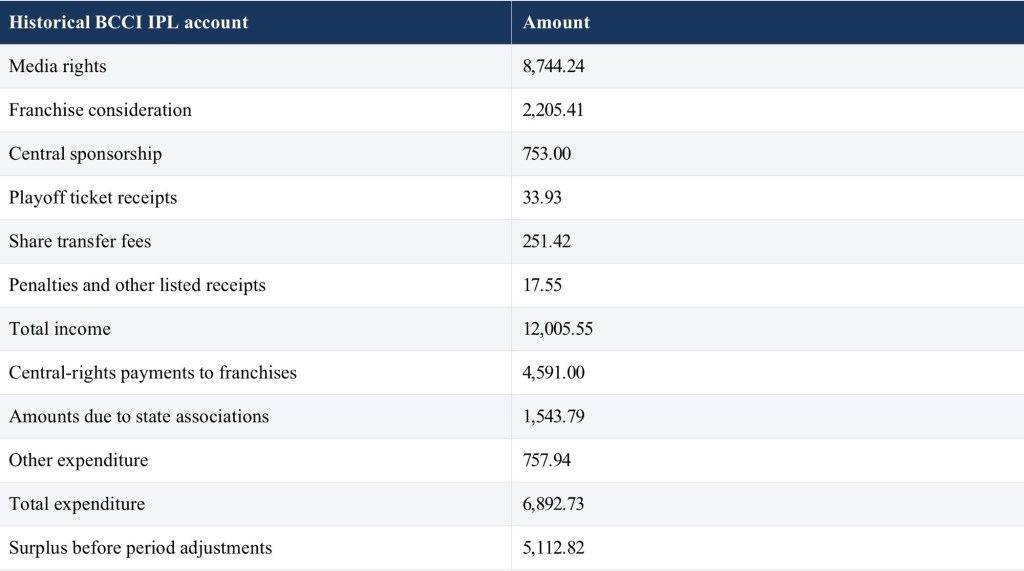
Source: BCCI FY2024–25 Schedule 8. Other expenditure and the grouped receipts are arithmetic residuals from the published schedule. [7]
This account shows where the money goes. A substantial part is distributed to franchises, while state associations also receive allocations. Those allocations are transfers within cricket institutions; they do not establish how much was subsequently spent on grassroots cricket or infrastructure.
Why the accounts cannot simply be added
If a broadcaster pays BCCI Rs 100 and BCCI passes Rs 50 to a team, the combined external income remains Rs 100. Recording Rs 150 would count part of the same money twice. When a team pays its franchise fee back to BCCI, that is another internal transaction to eliminate.
A correct combined league statement adds organiser income and IPL-only team operating income, then removes central-rights distributions, franchise consideration and other reciprocal transactions. Prize and playoff distributions also need matching eliminations. It must align seasons, exclude WPL and overseas leagues, and use consistent treatment of GST, hospitality, related-party deals and exceptional fees. Adding broadcaster advertising revenue to the league’s rights income would likewise mix successive stages of the value chain. A wider ecosystem account would have to consolidate those stages too.
Consequently, the earlier Rs 6,066 crore ten-company sum is retained only as an indicative sum of reported company operating revenues. The incomplete Rs 650.81 crore profit subtotal is withdrawn as a measure of IPL profitability. It combines unverified figures and differing business boundaries, with SRH profit missing. It should not be used as an overall league earnings claim.
Ticket sales and gate collections
Ticket income is additional external revenue when spectators or companies buy admission and hospitality. The crucial distinction is between home-match collections in franchise accounts and playoff collections in BCCI’s account. BCCI reports Rs 33.93 crore of IPL 2024 playoff ticket income, net of GST, based on the ticketing agency’s CA certificate. That figure covers playoffs, not the season’s entire gate collection. For 2026, BCCI appointed District by Zomato for playoff ticketing, but its announcement does not disclose the final receipts. [5,7]
A packed ground does not automatically mean every seat was sold. Complimentary allocations, blocked seats, refunds and premium boxes affect realised collections. Corporate hospitality must be separated into admission and services if the accounting requires it; premium-seat revenue must not be added again when already included in ticket yield. Resale prices are not franchise ticket revenue.
Formula: matches × paid attendees × net yield ÷ 10,000,000. The middle case represents 22.2 lakh paid visits and Rs 6 crore per match. For seven home matches, that arithmetic is Rs 42 crore. These are gross operating receipts before stadium rent, ticketing charges and match costs; they are not profit. Since all 74 matches are modelled, playoff receipts must not be added again. The three cases are scenarios, not a statistically validated range.
Advertising inside the stadium
The boundary board visible on television reaches viewers far beyond those in the ground. Its commercial value therefore depends on both stadium exposure and broadcast exposure. Central league sponsorships and permitted team sponsorship packages may include signage, dugout branding, screens, activation space or hospitality. Historical franchise-rights descriptions and official partner-rights notices show that the league controls important stadium assets.
Local stadium advertising needs a separate reconciliation, not an automatic extra line. If a brand pays Rs 10 crore for a package covering kit branding and signage, the revenue is Rs 10 crore. Assigning Rs 2 crore internally to signage does not create Rs 12 crore of revenue. Advertising sold independently to an external buyer can be additional income, provided it has not already entered sponsorship, event-management or commercial receipts.
Illustrative independent local ad sales Net new receipts per league

These amounts are assumed examples, not reported IPL advertising revenue. They cover league matches only and may be added to a model only after demonstrating they are incremental to existing packages. Without that demonstration, the separate addition is zero; the economic value of signage remains inside sponsorship income. No validated standalone total for 2026 local stadium advertising is established here.
The franchise businesses
The earlier reported revenue ranking places KKR, CSK and Mumbai at the top. That ranking remains provisional because company boundaries differ. The appendix preserves all ten entries with evidence status; the detailed audited examples below use CSK standalone and Indiawin Sports. A like-for-like IPL-only top-three financial breakdown is not established by the available disclosures.
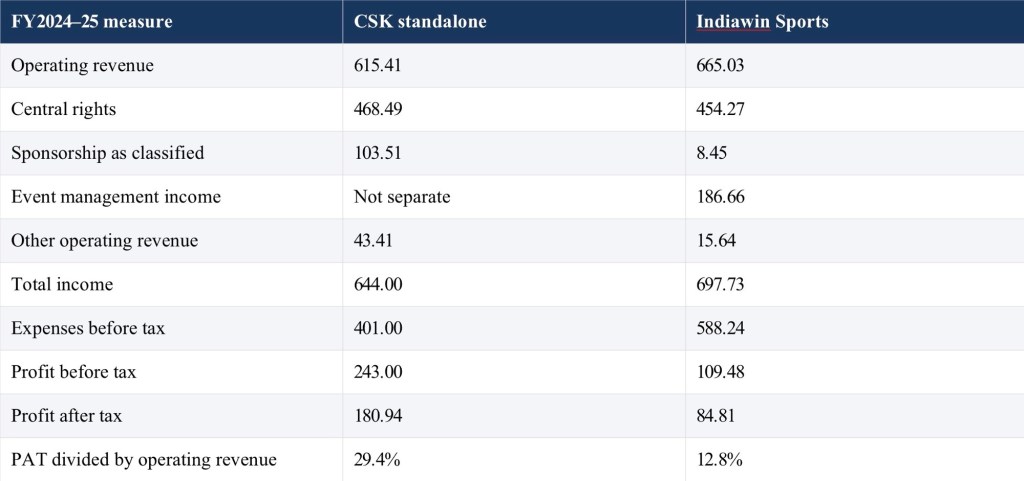
Sources: audited CSK and Indiawin FY2024–25 accounts. Ratios are author calculations. Indiawin’s event-management category cannot be recast as ticket sales or sponsorship without additional disclosure. Neither column is presented as a complete IPL 2026 season statement. [9,10]
In CSK’s standalone account, central rights supply 76.1% of operating revenue. Player and support-staff remuneration is Rs 127.72 crore, while the franchise fee is Rs 146.10 crore. Those figures show that player auctions are only one part of the cost structure. CSK consolidated operating revenue of Rs 673.80 crore and PAT of Rs 148.32 crore include additional businesses and must not be substituted for the standalone results. [9]
RCB provides a further historical comparison: financial reporting places FY25 operating revenue at about Rs 504 crore and PAT at about Rs 140 crore. The earlier Rs 21 crore profit figure conflicts with stronger reporting and is excluded. A 2026 media estimate of more than Rs 400 crore operating profit is not treated as audited evidence. [11]
Indicative ownership values of all ten teams
Valuation of IPL Teams
An ownership value is a stock of wealth representing expected future benefits, whereas season revenue is a flow. The two must be presented separately. The official March 2026 announcement records Rs 16,660 crore as consideration for 100% of Royal Challengers Sports Private Limited, including both IPL and WPL rights. It is an equity transaction benchmark, not an IPL-only enterprise value. The announcement was subject to closing conditions; it is not used here as proof of completion. [6]
To answer the question of what all ten teams might be worth on a somewhat similar basis, we use a transparent comparable-price illustration. Houlihan Lokey’s 2026 franchise brand values, reproduced by NDTV Profit, provide relative weights. These brand figures are not ownership prices. The conversion assumes that each franchise could command the same ownership-price-to-brand-value relationship as the RCB package. This is our modelling assumption, not Houlihan Lokey’s valuation method or a professional fair-value opinion. [15]
Formula: indicative price for team i = Rs 16,660 crore × team i brand value ÷ RCB brand value of US$312 million. Dollar amounts cancel in the ratio, so no exchange-rate assumption is needed. The resulting column is a package-equivalent comparison before correcting for RCB’s WPL component and differences in debt, cash, company scope or control rights. A second column assumes, solely for sensitivity analysis, that WPL accounts for 5% of the RCB package. It multiplies every estimate by 95% and is an IPL-only equity proxy, not an observed allocation.
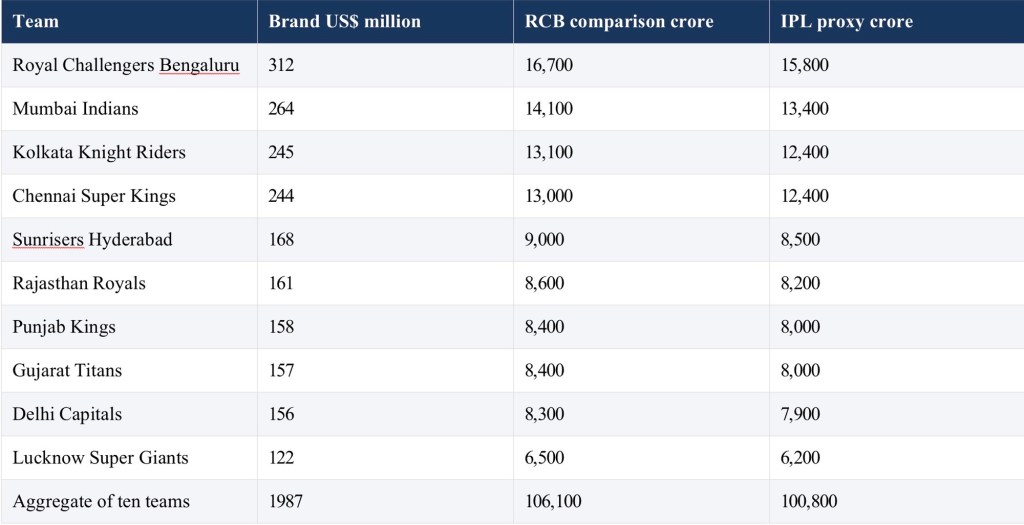
The ownership columns are author calculations rounded to the nearest Rs 100 crore. Aggregate values are calculated before rounding, so displayed team figures may not sum exactly. The brand column is the reported 2026 external input; the two ownership columns are hypothetical results. RCB’s Rs 16,700 crore display is the rounded Rs 16,660 crore transaction benchmark, not a new valuation. [6,15]
The package-equivalent aggregate is approximately Rs 106,100 crore, or Rs 1.06 lakh crore. Assuming a 5% WPL allocation gives an IPL-only proxy of approximately Rs 100,800 crore. The top three in this particular comparison are RCB, Mumbai and Kolkata; their combined package-equivalent value is approximately Rs 43,800 crore. This ranking differs from the earlier revenue ranking because the measures differ.
If the undisclosed WPL allocation is assumed to be anywhere from 0% to 10%, the aggregate IPL proxy spans approximately Rs 95,500 to Rs 106,100 crore. This interval tests only that one assumption; it is not a confidence interval or a market valuation range. Changing the RCB price anchor to the user’s rounded Rs 16,000 crore reduces the unadjusted aggregate to approximately Rs 101,900 crore.
A revenue-multiple comparison gives a useful warning. Dividing RCB’s Rs 16,660 crore package price by its approximately Rs 504 crore FY25 operating revenue produces 33.06 times revenue. Applying that mechanically to the appendix’s provisional Rs 6,065.83 crore company-revenue sum produces approximately Rs 200,509 crore. This much larger result is not adopted: it mixes reporting dates and business scopes, and assumes that higher revenue always deserves the same multiple. The revenue inputs are already provisional. It demonstrates how strongly the chosen method affects the answer, rather than independently validating either total.
There is also evidence that the simple brand ratio misses real transaction factors. Reporting on the 2026 valuation study describes a Rajasthan Royals transaction at US$1.65 billion, versus US$1.78 billion for RCB. That price ratio is approximately 92.7%, while the reported RR-to-RCB brand-value ratio is only 51.6%. The transaction scopes must be reconciled before comparison, but this discrepancy alone prevents treating the brand-ratio results as reliable fair values. We retain the calculation as the requested comparable illustration and explicitly decline to call it a validated ownership valuation. [16]
A defensible valuation would forecast each IPL-only business’s cash flows, including central distributions, ticket receipts, sponsorship, genuinely incremental local stadium advertising, franchise fees and player costs. It would examine the next media-rights cycle, reinvestment needs, taxes, net debt and cash, contract duration and transfer conditions. Comparable transactions would then cross-check the discounted-cash-flow result. Losses in a single year do not automatically make a franchise worthless, and a brand valuation should not be added to the resulting ownership value.
For the essay’s magnitude argument, the appropriate presentation is therefore two separate lines: recurring seasonal commercial receipts measured in many thousands of crores, and an explicitly modelled stock of team ownership value of roughly Rs 1 lakh crore on an RCB-anchored comparison. The ownership aggregate is neither annual turnover nor a consolidated valuation of BCCI and IPL. It must not be added to season revenue, to the league enterprise valuation, or to the brand values.
Players broadcasters and the wider economy
The official regulations set the 2026 total salary cap at Rs 151 crore per franchise, including auction purse, incremental performance pay and match fees. Across ten teams that is Rs 1,510 crore of aggregate permitted player compensation, not verified actual expenditure. Match fees of Rs 7.5 lakh per playing member, including the impact player, sit within this total cap and should not be added to it again. Coaches and support staff require separate accounting. [12]
The broadcaster has a different challenge. Its rights purchase must be supported by advertising, subscriptions and wider platform benefits, after production and distribution costs. Strong franchise profits do not establish broadcaster profitability. Nor does a sponsorship purchase establish that an advertiser earned a return; that requires evidence on sales, customer acquisition or brand outcomes.
Hotels, airlines, taxis, caterers, security staff, production crews and small vendors share in the activity around matches. These transactions matter, but adding every payment would inflate economic contribution. Teams’ hotel bills already sit in expenses. Visitor spending can displace other spending in the same city. A credible economic-impact calculation measures additional value added, adjusts for imports and displacement, and separates temporary jobs from continuing employment. This study therefore does not invent a GDP contribution, tax total or employment multiplier.
What the magnitude means
The evidence supports a substantial conclusion. IPL’s media and title-sponsorship contracts alone imply an annual average above Rs 10,000 crore. Gate collections can reach hundreds of crores under explicit paid-attendance scenarios. Sponsorship monetises both the team identity and the stadium experience. Player compensation operates within a league-wide framework of roughly Rs 1,500 crore in permitted spending for 2026. Ownership values capitalise expectations about future earnings, explaining why they are much larger than one season’s revenue.
The commercial strength comes from organising audience attention into scarce, repeatable rights. Central selling provides a large shared income base, while franchises develop their own brands and match experiences. Its financial vulnerability is dependence on future rights prices and the broadcasters’ ability to recover those prices. Its growth opportunity is to earn more from fans through better access, hospitality, merchandise and sustained engagement without counting the same receipt twice.
My assessment is that IPL is an important Indian sports and entertainment business with recurring receipts measured in many thousands of crores. For the latest season, the responsible headline is an annualised core contract benchmark of Rs 10,178 crore, alongside a separately labelled reported revenue projection above US$1.8 billion. An exact audited consolidated 2026 total is not established. That distinction preserves the strength of the argument: the magnitude is remarkable even after the accounting is made honest.
Appendix on validation of the ten team comparison
These are FY2024–25 reported operating revenues, mostly rounded, not IPL 2026 figures. Parentheses indicate losses. S means checked against an audited company report; R means financial-media reporting; P means provisional secondary comparison requiring filing verification. Mixed company scopes prevent a validated IPL-only aggregate. [9–11,13,14]
The provisional revenue sum is Rs 6,065.83 crore using the displayed inputs, or approximately Rs 6,066 crore. The earlier Rs 650.81 crore nine-company PAT subtotal used CSK profit rounded to Rs 148 crore. Using Rs 148.32 crore gives Rs 651.13 crore. Neither subtotal is validated league profit. KKR, CSK and Mumbai reported operating revenues sum to Rs 2,094.83 crore, or 34.5% of the provisional sum. Their mixed business scopes make this a company-scale comparison only.
A further source discrepancy concerns BCCI concessionaire receipts. The official indexed Schedule 8 shows Rs 0.53 crore; a secondary dataset displays Rs 10.53 crore. This report follows the official schedule, which reconciles to its stated total. An annualised media-rights average must not be substituted for the historical recognised Rs 8,744.24 crore. The 2026 season’s precise revenue requires season-matched accounts.
Sources and calculation basis:
[1] BCCI official media rights award for 2023–2027. https://www.bcci.tv/news/article/bcci-announces-the-successful-bidders-for-acquiring-the-media-rights-for-the-indian-premier-league-seasons-2023-2027
[2] IPL official Tata title sponsorship for 2024–2028. https://www.iplt20.com/news/article/tata-group-secures-title-sponsorship-rights-for-ipl-2024-28
[3] Houlihan Lokey official 2026 valuation announcement. https://hl.com/about-us/newsroom/ipl-reaches-us-206-billion-valuation-amid-record-franchise-deals/
[4] Variety coverage of the 2026 study via Yahoo Finance. https://finance.yahoo.com/media-advertising/articles/royal-challengers-bengaluru-rajasthan-royals-070000915.html
[5] IPL official 2026 playoff schedule and ticket announcement. https://www.iplt20.com/news/article/tata-ipl-2026-playoffs-tickets-to-go-live-from-may-20
[6] Diageo announcement of agreement to sell RCSPL. https://www.diageo.com/en/news-and-media/press-releases/2026/diageo-subsidiary-united-spirits-limited-announces-full-divesture-of-its-stake-in-royal-challengers-sports-pvt-ltd
[7] BCCI audited FY2024–25 accounts Schedule 8 and Note 21. https://documents.bcci.tv/bcci/documents/1767792705346_Audited-BCCI-Financials-2024-25.pdf
[8] IPL official expressions of interest for partner rights. https://www.iplt20.com/news/article/expressions-of-interest-for-ipl-partner-rights
[9] CSK annual report FY2024–25 statements and Notes 25–27. https://gallery.chennaisuperkings.com/PROD/INVESTOR_CORNER/DOCUMENT/INVESTOR_CORNER_1756730556104_570e54_1756730556104.pdf
[10] Indiawin Sports audited financial statements FY2024–25. https://www.ril.com/sites/default/files/2025-07/Indiawin_Sports_Private_Limited.pdf
[11] Economic Times reporting on MI RCB and LSG FY25 accounts. https://economictimes.indiatimes.com/industry/media/entertainment/media/ipl-franchises-mi-rcb-lsg-earnings-take-a-hit/articleshow/123350917.cms
[12] IPL official player regulations for 2025–2027. https://www.iplt20.com/news/article/ipl-governing-council-announces-tata-ipl-player-regulations-2025-27
[13] Technosports ten-team reported revenue comparison. https://technosports.co.in/ipl-franchises-revenue-indian-premier-league/?amp=1
[14] Provisional FY25 profit comparison with DC and Punjab figures. https://www.linkedin.com/posts/sunil-gurjar-cfte-6abbb6134_ipl-ipl2025-cricketbusiness-activity-7450410484090146816-U6sA
[15] NDTV Profit reporting of all ten 2026 Houlihan Lokey franchise brand values. https://www.ndtvprofit.com/sports/cricket-indian-premier-league-ipl-crosses-usd-20-billion-valuation-for-first-time-check-financial-ranking-of-all-10-franchises-11838164/
[16] Reuters reporting of RCB and Rajasthan ownership transactions in the 2026 valuation study. https://www.reuters.com/world/india/ipls-business-value-soars-above-20-billion-says-report-2026-07-29/
BCCI values were checked against search-indexed official schedule extracts because direct retrieval returned an access error. CSK and Indiawin PDF text was directly accessible. The full 2026 Houlihan Lokey PDF exceeded retrieval limits; its official valuation announcement and attributed media coverage were used instead. Local advertising and gate scenarios are author calculations, not source-reported actuals. No unsupported scenario is included in an audited total.


