India and China: Civilisational Moorings, Divergent Paths, and 21st Century Resonance
By CA. S. Muralidharan Business Mentor and Thought Leader
July 2026
Civilisations, unlike nations, are not born in a moment nor extinguished by conquest. They evolve over millennia, shaping the consciousness, institutions, and destinies of peoples. Among the world’s enduring civilisations, India and China stand out not only for their antiquity but also for their continuity — each a unique moral, philosophical, and political universe that has survived empire, invasion, and ideology. Yet their civilisational moorings and underpinnings, while equally deep, have led them down profoundly different paths in history and into the 21st century.
The story of their rise today — India as a pluralistic democracy and China as an authoritarian meritocracy — is not just a contest of political systems or economic performance. It is a civilisational divergence: a contrast between the Indian vision of moral pluralism and the Chinese vision of ordered unity.
Civilisational Foundations –
India: The Pluralistic Sacred Order
Indian civilisation rests on the concept of : –
Dharma — the moral, cosmic, and social order that sustains life. Unlike political or economic doctrines, dharma is not prescribed by the state; it arises from a moral consciousness shared across diverse sects, castes, and faiths. This has produced an enduring spiritual humanism, where the pursuit of truth (satya) is manifold and inclusive.
The Indian worldview regards the universe as an interconnected web of beings where harmony emerges through diversity. Hence, its society evolved not through uniformity but through accommodation — of ideas, languages, and faiths. From the Vedic hymns to Buddhist compassion, from Jain non-violence to Bhakti devotion, Indian thought celebrates multiplicity.
The state (rajya) in Indian tradition was never absolute. Power was legitimate only when aligned with dharma. Kings and rulers were judged not by conquest but by moral virtue — a principle that ensured both accountability and decentralisation. Local communities, guilds, and castes operated as self-regulating units, giving India a deeply rooted culture of plural governance.
China: The Hierarchical Secular Order
China’s civilisational foundation, by contrast, is Confucian and collectivist, centered on harmony through hierarchy. The universe is ordered under Tianxia — “All under Heaven” — with the Emperor as the Son of Heaven maintaining cosmic balance through moral authority. This worldview gave rise to the Mandate of Heaven, where the legitimacy of rulers derived from their capacity to preserve order and prosperity.
Confucian ethics emphasised Li (ritual, propriety) and Ren (benevolence), creating a social fabric bound by filial duty, respect for authority, and social harmony. The Chinese state evolved as the supreme moral and administrative institution, responsible not merely for law and order but for ensuring the moral cultivation of its people.
In short, India moralised society; China moralised the state. India decentralised power through communities; China centralised power through bureaucracy.
Historical Trajectories and Civilisational Effects of both civilisations:
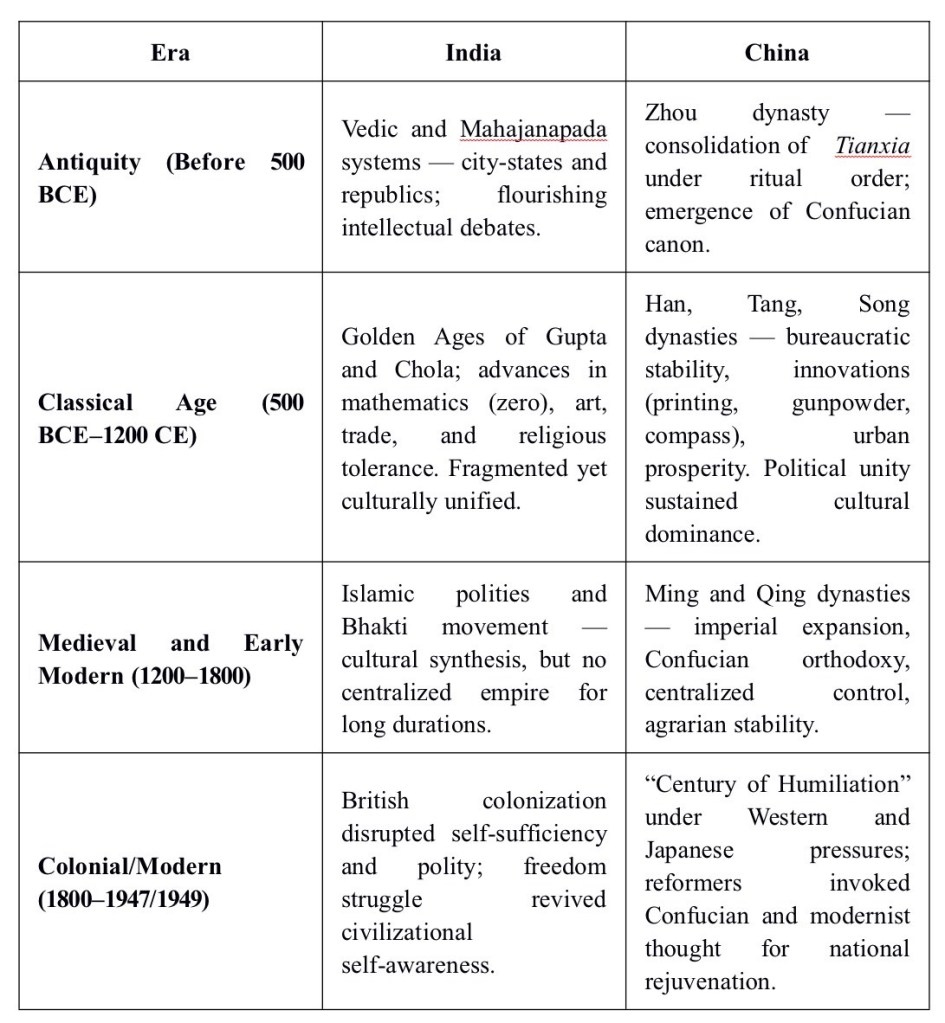
The imprint of their philosophies is visible in how both civilisations evolved historically as above.
India: Unity in Cultural Diversity
Ancient India was not a monolithic empire but a civilisational continuum of kingdoms, republics, and empires united by shared moral and cultural codes. The Mauryan and Gupta periods produced remarkable achievements in governance, mathematics, medicine, and art, but even these empires governed within the framework of local autonomy and cultural pluralism.
Buddhism and Jainism challenged ritual orthodoxy, while Bhakti and Sufi movements later democratized spirituality, erasing boundaries between elite and folk religion. This continual renewal from within kept Indian civilisation resilient, though politically fragmented.
The arrival of Islam and later European colonialism tested this resilience. Yet, even under foreign rule, India absorbed external influences without losing its inner continuity. The freedom movement of the 19th and 20th centuries, led by figures like Vivekananda, Aurobindo, and Gandhi, was not merely political—it was a civilisational reawakening. Gandhi’s Swaraj was as much about reclaiming the moral autonomy of civilisation as it was about ending colonial rule.
China: Unity through Centralised Authority
In contrast, China’s genius lay in creating political unity out of diversity. From the Qin unification in 221 BCE to the Han, Tang, and Song dynasties, China maintained a centralised imperial structure governed by the Confucian bureaucracy. The civil service examination system — meritocratic and disciplined — ensured administrative continuity for over two millennia.
Chinese civilisation valued stability over speculation. While India’s sages debated metaphysics, China’s scholars codified law, agriculture, and administration. The Confucian order proved so enduring that even Buddhism, when it entered China, was “Sinicised” — turned into an instrument of social harmony rather than spiritual rebellion.
However, this unity came at a cost: innovation often yielded to orthodoxy, and dissent was seen as disorder. The same bureaucratic rigidity that once ensured stability later hindered adaptation, particularly during the encounters with Western powers in the 19th century.
Colonial and Modern Encounters
Both India and China entered the modern era weakened by internal stagnation and external aggression. Yet their responses were shaped by their civilisational DNA.
India’s colonisation under the British fractured its economy but rekindled its moral-spiritual core. Reformers from Raja Ram Mohan Roy to Vivekananda sought to reinterpret ancient values for modernity. The independence movement, though political in form, was civilisational in essence — affirming pluralism, moral self-rule, and resistance to material domination.
China’s experience — the “Century of Humiliation” — provoked a different reaction. From the Opium Wars to Japanese occupation, China’s response was to reclaim state strength. Thinkers like Sun Yat-sen and later Mao Zedong sought to restore the Mandate of Heaven through revolutionary unity. The Communist Party became the new moral custodian, replacing Confucian virtue with ideological purity but retaining the civilisational idea of a strong central authority ensuring harmony.
The 21st Century: Civilisational Modernities Reimagined –
Today, both nations are reasserting their ancient identities in modern forms. The 21st century is not merely witnessing an “Asian rise,” but the return of civilisations long suppressed under Western dominance.
China: The Technocratic Civilisation-State
Under the Communist Party, China presents itself as a civilisation-state — a polity that sees legitimacy not from liberal consent but from civilisational continuity and performance. The Confucian ideal of order has merged with the technocratic drive of modernity.
Beijing’s Belt and Road Initiative echoes Tianxia — a vision of interlinked economic and moral order led by China. The state’s role as moral guardian has re-emerged, now clothed in the language of “common prosperity” and “national rejuvenation.” Yet, this model’s strength — discipline, unity, and speed — also reveals its vulnerabilities: suppression of diversity, moral conformity, and limited space for individual freedom.
India: The Pluralist Civilization-Nation
India’s rise, by contrast, is anchored in its civilisational pluralism and democratic ethos. Its political debates, religious diversity, and linguistic multiplicity echo its ancient capacity for synthesis. The Constitution, secular yet spiritual in spirit, reflects the principle that truth and legitimacy are plural. India’s soft power — yoga, Ayurveda, spirituality, diaspora, and moral diplomacy — arises from its civilisational conviction that the world is one family (Vasudhaiva Kutumbakam). Its challenge, however, lies in translating moral and cultural pluralism into institutional coherence and social equity.
While China seeks harmony through uniformity, India seeks harmony through diversity. One is centripetal, the other centrifugal.
Civilisational Contrasts in Modern Expression:
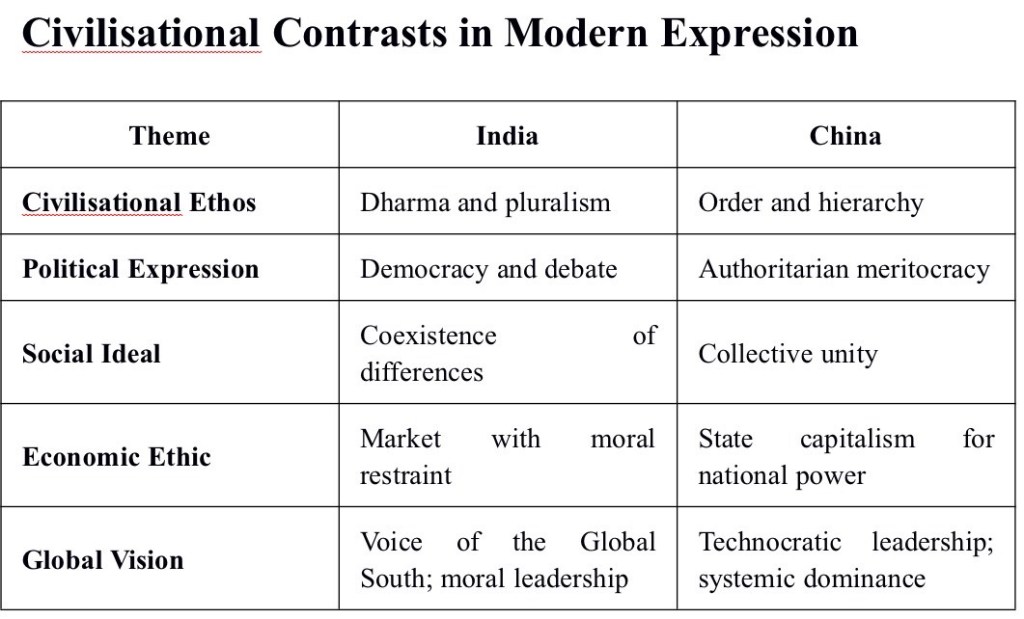
These contrasts are not temporary or accidental; they are civilisationally encoded. India’s social complexity produces debate and gradualism; China’s unity produces focus and speed. India evolves through dialogue, China through direction.
Implications for the 21st Century World Order
As the Western world grapples with internal crises of meaning, identity, and trust, both India and China project civilisational alternatives. Yet their models appeal to different imaginations.
China’s model attracts those seeking efficiency without democracy — a system where order and prosperity trump freedom. India’s model attracts those who believe diversity and democracy can coexist with growth and stability.
The future global order may well reflect a dialogue between these two Asian civilisations, each reasserting its moral grammar: India’s ethics of multiplicity and China’s ethics of order. The challenge for humanity is not to choose between them but to ensure that power, wherever it resides, remains anchored in moral legitimacy rather than material triumph.
Conclusion
The rise of India and China today is not the rise of two nations but of two civilisational archetypes. India represents the civilisation of the soul — rooted in moral pluralism and inner freedom. China represents the civilisation of order — rooted in collective harmony and disciplined statecraft.
Their journeys have been shaped by opposite impulses: India’s diffusion versus China’s consolidation, India’s diversity versus China’s unity. Yet both have preserved continuity when many other civilisations faded.
In the 21st century, as the West’s ideological dominance wanes, the world turns again to Asia — not merely for markets or technology, but for meaning. India and China offer two contrasting paths to modernity: one democratic and spiritual, the other authoritarian and technocratic. Their interplay will define the moral and political architecture of the century to come.
India seeks to lead by dialogue; China by design.
One appeals to the conscience, the other to control.
Together, they remind the world that civilisation — not ideology — is destiny.
Without understanding these fundamental differences between the two great civilisations, we cannot understand their economic growth and development and the dynamics or the under-current of their development in the 21st Century and beyond.
We will continue to study that in the coming days.

 Geopolitical Economy