India Preparing for Leadership in Artificial Intelligence
CA. S. Muralidharan
Business Mentor and Thought Leader
A ten country perspective for industry leaders and policymakers
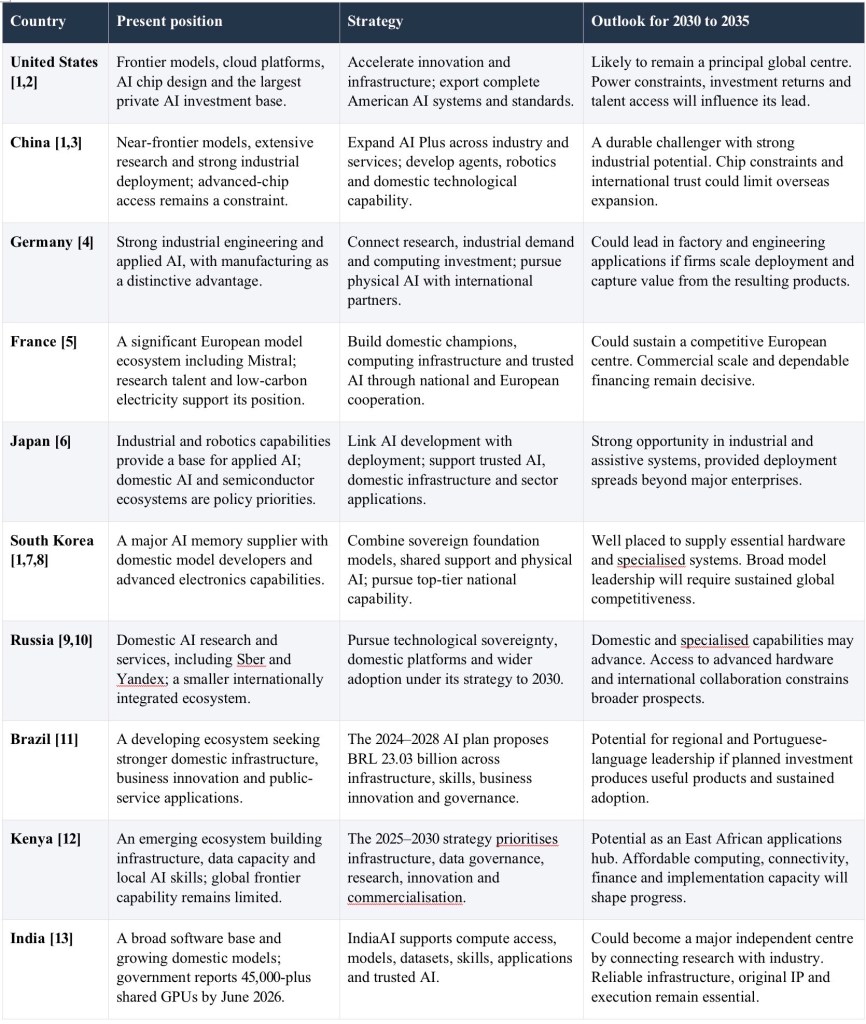
The United States and China dominate much of the debate about artificial intelligence. A comparison across ten countries shows a wider contest. Some nations compete in advanced models. Others build strength in chips, factory systems or locally useful applications. India should learn from these different paths while developing the capability to shape its own future.
The ten country comparison
This is a qualitative comparison, not an official ranking. Evidence has different reference dates. Strategy describes policy direction; it does not establish delivery. The 2030–2035 outlook is the author’s conditional assessment, not a forecast guaranteed by the sources.
China building AI capability over fifteen years
China’s rise offers a useful case study for 2011–2026, although its scientific and industrial foundations predate this period. Its present position emerged through successive investments by companies, universities and government. The record supports a lesson about sustained capability building. It does not establish that every policy succeeded or that central direction alone produced the results.
2011 to 2015 building commercial research
Early company investment preceded the dedicated national AI plan. Baidu established its Institute of Deep Learning in 2013. In 2014 it opened a Silicon Valley laboratory and appointed Andrew Ng to lead Baidu Research. Its announcement identified work on speech, images, language and advertising. These were research problems connected to existing businesses, providing a route from experimentation to practical use. [16]
This experience also challenges the idea that China developed AI in isolation. International recruitment and research connections contributed to its capabilities. For India, the lesson is to create attractive research opportunities at home while remaining connected to global knowledge.
2015 to 2018 aligning policy industry and universities
China’s 2015 development programme linked Internet Plus, cloud computing and AI with industrial upgrading. The 2017 New Generation Artificial Intelligence Development Plan then established a dedicated national direction towards 2030. In the same year, Alibaba launched DAMO Academy as a global research programme. Its announcement proposed investment exceeding US$15 billion over three years across research and development; that was a commitment, not verified AI expenditure. [17–19]
University preparation followed alongside company research. The Ministry of Education’s 2018 action plan sought stronger AI disciplines, innovation and talent development. Alibaba and Tsinghua University also announced a joint laboratory in 2018. Together, these milestones show several institutions working on connected priorities. They do not prove that a national announcement automatically produced commercial success. [20,21]
2019 to 2022 connecting software hardware and infrastructure
Alibaba unveiled an AI inference chip in 2019. Inference means running a trained model to produce an answer or prediction. This illustrates a company moving from using AI towards designing part of the infrastructure supporting it. It did not make China independent in advanced chips. [22]
In 2022, China approved eight national computing hubs and planned ten data-centre clusters under East Data West Computing. The programme sought to connect demand in eastern regions with resources in western regions. This was broader digital infrastructure, not exclusively AI investment. India can learn from coordinating computing with energy and networks, while matching location to latency, water availability and actual demand. [23]
2023 to 2026 competing in models and deployment
DeepSeek-V3, released in December 2024, demonstrated another route to competitiveness: efficient model architecture and engineering. Its technical report described a model activating only part of its total parameters for each token and using 2.788 million H800 GPU hours for training. This is a developer-reported training figure, not the full cost of establishing the company or conducting all earlier research. [24]
By the 2026 AI Index, China produced 30 notable models in 2025 against America’s 50. China’s share of the top 100 most-cited AI papers rose from 33 in 2021 to 41 in 2024. These indicators suggest growing capability, but neither model counts nor citation shares measure every aspect of quality or economic value. China’s AI Plus programme now seeks wider adoption across industry and public services. [25,26]
What India should learn
The interpretation is that China built reinforcing connections between research, talent, companies, infrastructure and customers. India should strengthen these connections through sustained funding, competitive institutions and industrial demand. Businesses must contribute original research and product development alongside government investment.
There are limits to the example. US export controls introduced in October 2022 restricted access to advanced computing and chipmaking technologies. China’s progress therefore demonstrates substantial capability without establishing complete self-sufficiency. Nor does it prove that India must reproduce China’s political system. India should build with open competition, privacy protections and public accountability. The relevant lesson is continuity of effort and coordinated execution. [27]
What the comparison means for India
The comparison suggests that leadership has several forms. America combines research, capital and platforms. China connects AI with industrial scale. Germany and Japan offer lessons in linking technology with engineering. South Korea demonstrates the value of an essential hardware position. France seeks technological ownership alongside partnerships. Brazil and Kenya show why local needs and public services deserve a place in national strategy. Russia illustrates the importance of sustaining capability when international access is constrained.
India should therefore pursue both original technology and broad adoption. It should develop domestic models, hardware capabilities and research while helping enterprises use the best suitable systems. The test is whether India owns more valuable technology, retains strategic choice and becomes more productive. The programme below sets out how industry and government can prepare together.
Defining leadership in Indian terms
India should define success through three outcomes: strategic choice, ownership of valuable technology and improvements in national productivity. A large number of users or data centres does not by itself demonstrate leadership. We must ask who owns the products, who earns the profits and whether Indian enterprises become more competitive.
Complete technological self-sufficiency is neither a practical near-term objective nor a sensible test of success. India should build domestic strength in critical areas while diversifying international partnerships. The ability to evaluate, adapt, operate and replace important technologies matters greatly. Foreign investment and Indian ownership can both contribute, provided policy pays attention to the capabilities created within the country.
Building on the existing foundation
India is already investing through the IndiaAI Mission. Government reporting records shared computing capacity exceeding 45,000 graphics processing units by June 2026 and the selection of 20 indigenous foundation-model proposals. These are useful beginnings. They represent resources and commitments, however, rather than proof of technological leadership or economic returns.
The next task is to turn these inputs into dependable services, strong research and successful products. Researchers need suitable computing capacity when their projects require it. Startups need clear access rules and predictable costs. Public reporting should distinguish available capacity from actual usage, and selected proposals from working technologies that have passed independent evaluation.
Preparing people for different responsibilities
The educational foundation begins with reading, mathematics, scientific thinking and clear communication. Students must learn to question an answer, examine evidence and recognise uncertainty. These abilities become more valuable when machines can produce convincing text quickly. Introducing AI tools into classrooms will achieve little if students cannot assess what those tools produce.
Preparation should then follow different paths. Researchers need advanced mathematics, computing and opportunities for sustained experimentation. Managers and professionals need industry knowledge, process design and the ability to evaluate AI systems. Workers and small entrepreneurs need practical tools, local-language support and training connected to their daily tasks. One standard certificate cannot meet these different needs.
Colleges should work with local enterprises on actual problems.
Engineering students could study machine failures, commerce students could examine inventory and cash flow, and agricultural students could evaluate advisory tools. Assessment should require students to explain both their results and their verification methods. Success should be measured through demonstrated ability and improved work, rather than enrolment numbers alone.
Making enterprises ready
Many businesses need better records and clearer processes before they need sophisticated AI. Incomplete accounts, inconsistent inventory data and responsibilities held only in one employee’s memory weaken any technology project. Industry associations should help firms organise information, document important activities and identify a problem worth solving.
Each project should begin with a baseline. A manufacturer should know its existing rejection rate before testing automated inspection. A distributor should measure delivery delays before adopting route planning. Businesses must include software charges, integration, supervision, maintenance and errors when calculating returns. A promising demonstration becomes a business investment only when the benefits survive these costs.
This creates a practical role for chartered accountants, business mentors and other professional advisers. They can assess readiness, validate savings, examine controls and help owners choose realistic projects. Advisers must also recognise the limits of their technical expertise and involve specialists where necessary. Their contribution is to connect technology spending with business purpose and accountable decisions.
Connecting AI with manufacturing
India’s AI strategy should be closely connected with its manufacturing ambitions. Software becomes economically powerful when it improves machines, materials, production and logistics. Useful applications include detecting defects, anticipating equipment failures, reducing energy consumption and improving production schedules. Better design and testing can also help Indian firms develop stronger products.
Industrial clusters offer a practical starting point.
In Coimbatore, for example, manufacturers, engineering institutions, technology firms and industry associations could jointly test a small set of applications. A proposed programme might begin with 100 willing enterprises, establish their present performance and assess results after six months. This is an illustrative proposal, not an existing government commitment.
Independent evaluation should establish which applications work, for which firms and at what cost. Successful approaches could then spread to other clusters. Such programmes would also create demand for Indian technology suppliers. The aim is to build commercially sustainable relationships between developers and enterprises, with public support helping overcome early coordination and experimentation costs.
Supporting research and ownership
India needs research institutions that offer reliable funding, capable leadership and access to computing infrastructure. Researchers must have time to pursue difficult questions. Funding should tolerate genuine experimental failure while requiring honest reporting, independent review and evidence of progress. Repeated announcements and short competitions cannot substitute for sustained research careers.
Universities and businesses should agree early on intellectual-property rights, publication and commercial use. Several competing teams should receive opportunities, including teams working on ambitious general models and others developing efficient sector or language systems. Diaspora researchers can contribute through joint laboratories, visiting appointments and mentoring. Permanent relocation should not be the only route to participation.
Financing the physical foundations
AI depends on electricity, networks, servers, cooling and maintenance. The International Energy Agency projects global data-centre electricity demand to roughly double between 2025 and 2030. India must therefore plan computing infrastructure alongside dependable power and transmission. Water requirements, local conditions and the needs of surrounding communities also deserve attention.
Investment decisions should reflect the rapid ageing of computing equipment and uncertainty about future demand. Public procurement must consider operating costs and supplier dependence throughout an asset’s useful life. In semiconductors, India should pursue credible capabilities in design, packaging, testing, systems engineering and selected manufacturing, supported by partnerships. Announced investment is an inadequate substitute for competitive production and domestic value creation.
Creating demand and suitable finance
Research, product development and commercial expansion require different financial instruments. Public grants suit foundational research and shared datasets. Early companies need patient investment and access to facilities. Paid pilots help establish whether customers value a product. Commercial expansion should increasingly depend on customer revenue and investment based on credible prospects.
Government purchasing can help promising firms cross the gap between a prototype and a usable service. Departments should define problems clearly, fund limited trials and expand independently verified successes. Contracts should require security, portability and measurable service improvements. Domestic suppliers should meet meaningful performance standards so that public support develops firms capable of competing internationally.
Protecting trust and supporting workers
AI adoption will face resistance if people experience unexplained decisions, unreliable services or misuse of personal information. Organisations should identify who remains responsible when a system makes a mistake. In consequential decisions, people need a practical way to seek review. Tests should examine reliability across languages and user groups, alongside security and privacy.
Government and employers must also prepare for changes in entry-level work. Apprenticeships, workplace training and pathways into new responsibilities should accompany automation. Firms should consider how junior employees will acquire experience when routine tasks are automated. Productivity gains will have limited social value if they weaken the routes through which young people enter skilled employment.
Building international relationships with purpose
India should negotiate technology partnerships around specific capabilities: access to advanced chips, joint research, manufacturing knowledge, talent mobility and overseas markets. Working with several partners can reduce vulnerability. Essential systems should have credible alternatives if commercial terms or geopolitical conditions change. Supplier diversity must be planned before a disruption occurs.
India can also develop affordable products for countries facing similar problems in language access, education, healthcare and small-business productivity. International credibility will depend on evidence of usefulness, responsible handling of data and dependable support. Export ambition should encourage Indian firms to meet demanding standards from the beginning. A large home market provides an opportunity to learn, but does not guarantee overseas success.
Turning preparation into execution
Execution should build on the existing IndiaAI structure, with clear responsibilities across ministries, states and participating institutions. A delivery team needs authority to resolve delays and publish progress. Industry must contribute operational expertise, customer access and investment. Universities should provide research and evaluation. Each programme needs a named leader, a budget, a baseline and a review date.
During the first six months, the priority should be to identify bottlenecks and select a manageable set of sector and district programmes. Over the following year, these programmes should run workplace training, paid pilots and research projects. During years two and three, independently verified successes should expand, while weak programmes should be redesigned or closed. These are proposed stages, rather than existing official commitments.
Public dashboards should report useful results: access delays, sustained customer use, productivity improvements, Indian intellectual property, exports and workforce outcomes. Reviews should examine who benefited and whether results can survive without continuing subsidy. Budgets must remain open to revision as evidence develops. Accountability requires the willingness to stop a visible project when it fails to deliver.
A responsibility shared by industry and government
Industry leaders should begin with their own enterprises. They can appoint a responsible executive, assess data quality, select a few valuable problems and train the teams involved. Policymakers should make research, infrastructure and fair access dependable. State governments and associations can connect these national foundations with the everyday needs of local enterprises.
India’s position in the AI age will depend on the capabilities it builds repeatedly: developing technology, applying it well and spreading the gains. Leadership will become credible when Indian products earn international customers, factories become more productive and public services improve. Preparing for that future is a sustained responsibility for institutions and enterprises alike. The work can begin now, with clear ownership and results that people can verify.
Sources and assessment notes
Bracketed numbers in the comparison and case study identify the sources below. Country outlooks, proposed programmes and execution stages are the author’s assessment and recommendations. Government and company claims are not treated as independent proof of performance. Hardware restrictions affecting Russia and international trust affecting China are analytical risk judgements. No comparable ten-country spending or capability score is claimed.
- Stanford HAI2026 AI Index. Cross-country research and investment evidence; measures refer to different underlying dates. Private investment does not measure total national AI expenditure.https://hai.stanford.edu/ai-index/2026-ai-index-report
- White HouseAmerica’s AI Action Plan, July 2025. Policy direction, rather than evidence that all actions have been completed.https://www.whitehouse.gov/releases/2025/07/white-house-unveils-americas-ai-action-plan/
- State Council of ChinaChina to advance smart economy, March 2026. AI Plus and the proposed 2026–2030 planning direction.https://english.www.gov.cn/2026special/2026npcandcpcc/202603/05/content_WS69a92040c6d00ca5f9a09916.html
- German Federal GovernmentIndustrial AI cooperation with international partners, October 2026.https://www.bundesregierung.de/breg-de/aktuelles/pressemitteilungen/bundesregierung-staerkt-entwicklung-und-anwendung-industrieller-ki-ueber-zusammenarbeit-mit-internationalen-partnern-2457620
- Presidency of FranceFrance India innovation address, June 2026. Official discussion of Mistral, research, electricity and AI infrastructure.https://www.elysee.fr/emmanuel-macron/2026/06/14/deplacement-a-nice-avec-narendra-modi-premier-ministre-de-linde
- Cabinet Office of JapanBasic Policies 2025. Domestic semiconductor and sovereign AI ecosystem priorities.https://www5.cao.go.jp/keizai-shimon/kaigi/cabinet/honebuto/2025/2025_basicpolicies_en.pdf
- South Korean Ministry of Science and ICTSovereign AI foundation model project and competitive team selection, 2026.https://www.msit.go.kr/eng/bbs/view.do?bbsSeqNo=42&mId=4&mPid=2&nttSeqNo=1212&sCode=eng
- SK hynixAI memory products and development direction at FMS 2026. Company reporting.https://news.skhynix.com/en/fms-2026/
- Russian Federation contribution to UN CSTDScience Technology and Innovation in the age of AI, 2025–2026. National strategy and research capacity; government self-report.https://unctad.org/system/files/non-official-document/cstd2025-26_ai_c18_russia_ru_en.pdf
- Yandex ResearchResearch areas and domestic research activity.https://research.yandex.com/research-areas
- Brazilian Ministry of Science Technology and InnovationBrazilian AI Plan 2024–2028, English edition. The BRL 23.03 billion figure is proposed investment, not verified disbursement.https://www.gov.br/mcti/pt-br/acompanhe-o-mcti/transformacaodigital/ai-for-the-good-of-all-2025.pdf
- Kenya Ministry of Information Communications and the Digital EconomyNational AI Strategy 2025–2030 implementation roadmap.https://www.ict.go.ke/sites/default/files/2025-12/Kenya%20National%20AI%20Strategy%202025-2030%20Implementation%20Roadmap.pdf
- Press Information Bureau of IndiaGovernment Expands Sovereign AI Infrastructure, August 2026, and IndiaAI factsheet. Selected proposals are distinct from independently validated models.https://www.pib.gov.in/PressReleasePage.aspx?PRID=2295477&lang=1®=3https://www.pib.gov.in/PressReleasePage.aspx?PRID=2298788&lang=1®=6
- International Energy AgencyKey Questions on Energy and AI. Electricity demand figures are projections.https://www.iea.org/reports/key-questions-on-energy-and-ai/executive-summary
- Gordon G ChangDo Not Let China Cow Us on AI, Gatestone Institute, 30 October 2026. Opinion article that prompted the original discussion.https://www.gatestoneinstitute.org/22956/china-ai-competition
- BaiduSilicon Valley laboratory and Andrew Ng appointment, May 2014. Includes the 2013 institute milestone.https://ir.baidu.com/news-releases/news-release-details/baidu-opens-silicon-valley-lab-appoints-andrew-ng-head-baidu/
- State Council of ChinaEconomic and social development plan, March 2015. Internet Plus, AI and industrial upgrading.https://english.www.gov.cn/archive/publications/2015/03/17/content_281475073048566.htm
- State Council of ChinaGazette recording the New Generation AI Development Plan, August 2017.https://english.www.gov.cn/archive/state_council_gazette/2017/08/10/content_281475782151912.htm
- Alibaba GroupDAMO Academy launch, October 2017. Announced R&D commitment covers multiple technologies.https://www.alibabagroup.com/en-US/document-1491841175609409536
- Ministry of Education of China via State Council portalUniversity AI action plan, April 2018. Policy goals rather than independently verified outcomes.https://english.www.gov.cn/state_council/ministries/2018/04/13/content_281476110576084.htm
- Alibaba GroupJoint laboratory with Tsinghua University, April 2018.https://www.alibabagroup.com/en-US/document-1493727652601659392
- Alibaba GroupAI inference chip announcement, September 2019. Company reporting.https://www.alibabagroup.com/en-US/document-1491206538574954496
- State Council portalNational computing hubs project approval, February 2022. Planned infrastructure is distinct from operational capacity.https://english.www.gov.cn/statecouncil/ministries/202202/18/content_WS620ed1c7c6d09c94e48a52be.html
- DeepSeekDeepSeek V3 Technical Report, December 2024. Architecture and GPU hours are developer reported.https://arxiv.org/abs/2412.19437
- Stanford HAI2026 AI Index research chapter. Counts concern notable models in 2025 and highly cited papers in 2021 and 2024.https://hai.stanford.edu/assets/files/ai_index_report_2026_chapter_1_research_development.pdf
- State Council of ChinaAI Plus integration guideline, August 2025. Adoption ambitions are policy targets.https://english.www.gov.cn/policies/latestreleases/202508/27/content_WS68ae7976c6d0868f4e8f51a0.html
- US Bureau of Industry and SecurityAdvanced computing and semiconductor manufacturing export controls, October 2022. Historical milestone; subsequent rules have changed.https://www.bis.gov/node/20292


