Foreign Investment and Technology Development in India
Lessons from Indian manufacturing and China for Viksit Bharat
CA. S. Muralidharan, Business Mentor and Thought Leader
Research and policy paper | Updated 20 October 2026
Manufacturing capability for Viksit Bharat
India already has an example of how foreign investment can help build a strong industry. We can see it in the cars made on our roads today. Foreign companies brought investment, production methods and access to overseas markets. Indian workers, engineers and suppliers learned, invested and improved their capabilities. Vehicles made here began reaching customers around the world.
For the Viksit Bharat ambition, India should seek more from FDI than a larger inflow of money. Each major investment offers a chance to deepen the skills and technologies already present here and broaden the range of products Indian firms can make. The important test is whether these investments leave a stronger manufacturing economy around them.
Many vehicles can now be manufactured in India through the main stages of production, including components, body manufacture, assembly and testing. That is a considerable achievement. But it does not mean every part, machine or design is Indian. A car can be made in India while using some imported components and foreign technology.
We should recognise the progress while being clear about what remains to be developed.
Maruti–Suzuki and Hyundai show how this can happen over time. Locomotives, construction machinery, medical equipment and industrial drives provide further examples. Foreign investment was one part of these stories. Indian enterprise, domestic demand, procurement and public infrastructure also mattered. The examples establish useful pathways, rather than a numerical estimate of the contribution of FDI alone.
Automobiles and the foundations of industrial power
A strong automobile industry can do far more than put vehicles on the road. It brings together metallurgy, precision machining, electronics, software, materials, logistics and safety engineering. Thousands of suppliers must meet demanding standards repeatedly and at competitive cost. When this knowledge spreads to Indian firms and workers, it can strengthen machinery, railways, medical equipment and other industries.
Automobiles and aerospace are both sophisticated industries. Aerospace requires especially demanding certification and safety standards; automobiles combine complex engineering with production at far greater scale. There is no objective universal ranking of their technological advancement. The strategic opportunity is to build the skills, suppliers and institutions that serve both.
The international production gap
Our recent ten-nation comparison illustrates the distance India still has to travel. For a consistent benchmark, German Federal Statistical Office data show that in 2024 China produced approximately 27.48 million passenger cars, Japan 7.14 million, India 4.99 million and Germany 4.07 million. China therefore produced about 5.5 times India’s output. These are passenger cars, not all motor vehicles; production location does not establish ownership of technology or domestic value added.
Our recent 2025 comparison estimated China at 29.9 million and India at 5.23 million. A larger output can help sustain specialised suppliers and spread investment costs, but scale alone does not prove profitability, technological leadership or national prosperity.
Lessons from manufacturing nations
Japan built internationally competitive automotive firms through production discipline, quality improvement, supplier development and exports.
Germany combined precision engineering, technical training and specialist suppliers with internationally recognised products.
South Korea built domestic firms and export capacity while progressively developing engineering and brands. Their experiences differ, but each illustrates the value of persistent investment in people and production capability.
China combined international partnerships and a large domestic market with supplier investment, infrastructure, domestic enterprise and policy support. Its electric vehicle rise also reflects battery expertise and competition.
According to the International Energy Agency, China accounted for about 70 per cent of global electric-car production and over 80 per cent of battery-cell production in 2025.
A strategic agenda for India
India should aim to turn production growth into deeper engineering capability. The practical priorities are advanced components and tooling; battery cells and materials; power electronics and software; testing and certification; skilled technicians; and competitive exports. Foreign investment can accelerate learning when Indian firms obtain demanding work, while domestic enterprises invest in design and their own products.
A five-year national and state scorecard should track actual investment, skilled jobs, supplier productivity, qualified local suppliers, domestic value added, engineering responsibility, research outcomes and repeat exports.
These measures should be assessed against public support and commercial viability. A local purchase is not necessarily entirely Indian value added; an assembly plant is not proof of technology ownership.
Manufacturing clusters like Coimbatore, Pune could pilot supplier-development programmes connecting vehicle and machinery manufacturers with foundries, precision engineering firms, colleges, lenders and shared testing facilities. Anchor customers should specify standards and provide trials; firms should compete for orders on quality and cost. The resulting capability can support industries beyond automobiles.
Maruti Suzuki and the development of local capability
Suzuki’s joint-venture agreement with the Government of India was signed in 1982, and production of the Maruti 800 began in December 1983. Suzuki reported in its 2019 annual report that the local procurement rate of parts had reached 95 per cent.
Supplier development is a particularly useful part of the example. Maruti’s 2019–20 annual report describes support and training for suppliers, including smaller suppliers, through the Maruti Suzuki Supplier Welfare Association and the Maruti Centre for Excellence. It illustrates how a manufacturer can help firms around it improve their production practices.
By FY2024–25, Maruti Suzuki exported 332,585 vehicles, accounting for nearly 43 per cent of India’s passenger-vehicle exports. The company identified South Africa, Saudi Arabia, Chile, Japan and Mexico as its five largest export markets. It also reported starting exports of the Fronx and five-door Jimny to Japan during that year.
Exports show that vehicles made in India can find buyers abroad, including in the foreign partner’s home country. Winning those orders requires acceptable quality, reliable delivery and products customers want. Suppliers benefit when overseas demand creates more orders. Export success, however, does not tell us how much of each vehicle’s value was created in India.
Hyundai and the emergence of an export base
Hyundai provides a second example of foreign investment developing into sustained production and exports. In its 2026 thirtieth-anniversary release, the company reported cumulative sales from its Indian operations exceeding 13.5 million vehicles, including more than 3.9 million exported to 150 countries. These are company-reported cumulative figures, not annual exports.
In September 2026, Hyundai described a network of more than 1,400 local suppliers and over 900 local engineers, together with a target to source 90 per cent of vehicle content locally by 2030. The target is prospective and its scope should not be confused with earlier model-specific or manufacturing-specific localisation statements.
For Tamil Nadu, Hyundai is a useful example of how a large manufacturer can create opportunities for businesses around it. The practical task is to help local suppliers meet the manufacturer’s requirements. That may involve better equipment, tighter quality control or stronger engineering skills. The opportunity is clear, although this paper does not estimate the size of Hyundai’s wider benefits to the state.
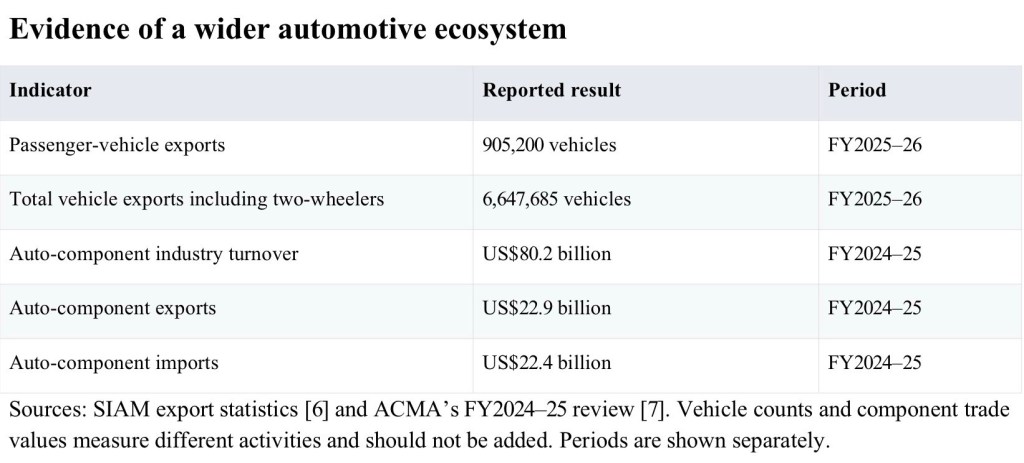
These figures tell us two things. India makes components that overseas customers are willing to buy. At the same time, Indian production still uses many imported components. ACMA identifies gaps in semiconductors, sensors, advanced transmissions and certain engine components. As vehicles become more electric and software-driven, Indian firms will need to keep learning and investing.
Indian manufacturers and independent suppliers deserve their share of the credit. Foreign-owned companies did not build this industry on their own. The useful lesson is that foreign investment works best when Indian businesses also have room to invest, compete and develop products.
Evidence from other Indian industries
The automotive experience is part of a wider pattern. Other industries show how foreign investment can help India manufacture advanced equipment, develop suppliers and serve overseas customers. Each case also highlights a different condition for success.
Railway orders that support manufacturing and exports
The Madhepura electric-locomotive project brought together Alstom and Indian Railways in a joint venture with equity shares of 74 per cent and 26 per cent respectively. Alstom’s engineering centre in Bengaluru contributed to the design work. The project established production of 12,000-horsepower freight locomotives in Bihar.
Alstom reported delivery of the 500th locomotive in March 2025, with localisation approaching 90 per cent. This is a company-reported measure. A continuing railway order helped provide a basis for production, maintenance and local sourcing. My policy reading is that dependable demand can make investment in skills and suppliers commercially worthwhile.
The Marhowra project provides a related export example. Wabtec’s joint venture with Indian Railways developed a supplier base while manufacturing locomotives for domestic use. The government identified that network as part of the plant’s development into a global manufacturing site. In June 2025, its first export locomotives were flagged off for delivery to Guinea’s Simandou railway project.
These projects suggest that public procurement can support more than the purchase of equipment. Where demand is credible and contracts are well designed, it can encourage local production and technical learning. Suppliers must still meet quality and cost requirements. An export order provides a further commercial test beyond the original Indian customer.
Construction equipment with substantial local production
JCB has operated in India since 1979. Its disclosures describe the Indian-made backhoe loader as more than 95 per cent indigenised. Its March 2024 announcement reported six manufacturing facilities and exports of Indian-made machines to over 130 countries. These are company statements, and the localisation percentage applies to the specified product rather than every machine.
The lesson is relevant to industrial machinery more broadly. India’s demand can support production scale, while international orders can widen the market. Around that production, firms have opportunities in components, tooling, maintenance and engineering. Policy should help them qualify for those opportunities and win business on their performance.
Medical technology and industrial equipment
Wipro GE Healthcare’s Revolution Aspire CT scanner offers an example of local product development. At its 2022 launch, the company described the scanner as designed and manufactured end-to-end in India at its Bengaluru facility. That description does not establish that every component or underlying technology is indigenous. It does show the scope for combining international expertise with work undertaken by Indian technical teams.
ABB illustrates another route.
In 2023, it expanded production of variable-speed drive modules at Peenya in Bengaluru for domestic and global customers. These devices help control the speed of industrial motors. Such equipment can improve the operations of other manufacturers, so the benefits of investment can extend to industries that use the resulting products.
Together, these cases suggest that India should encourage engineering responsibility as well as factory activity. Technical teams gain more when they can develop applications, validate performance and solve customer problems. Measuring these activities gives a fuller picture than counting installed production capacity alone.
Aerospace shows the value of supplier qualification
The Tata–Airbus C295 programme is a useful related example, although an industrial partnership or manufacturing contract should not automatically be counted as FDI. Airbus reported in October 2024 that the programme envisaged manufacturing 13,000 detail parts in India, with 21 special processes certified and 37 India-based suppliers onboarded. These figures describe the programme and its supplier preparation, rather than completed output of every planned aircraft.
The relevant lesson is that advanced manufacturing needs qualified suppliers and verified processes. Investment promotion must therefore connect with testing, certification and training. Across these examples, the common opportunity is to develop the surrounding economy alongside the main factory. Local production and technology ownership remain separate achievements.
How foreign investment can become domestic capability
A good place to begin is the relationship between a manufacturer and its suppliers. Suppose an Indian supplier receives an order for a more precise component. It may need better machines, measuring equipment and production records. A steady order can make that investment worthwhile. Technical help from the customer can make the learning easier.
World Bank research identifies such supplier relationships as a direct way for knowledge and productivity gains to spread.
The Indian firm must be ready to learn. Its engineers need to understand the process, find the causes of failures and make improvements. Its managers need to organise production and finance the work. Smaller firms often need help with these tasks. OECD guidance links successful learning to skills, finance, research resources and local institutions.
Learning becomes more valuable when a firm can improve what it has learned. It might redesign a fixture to reduce waste or change a process to suit local materials. It might develop a cheaper component for another customer. These practical improvements build engineering confidence. We should judge them by better quality, productivity and repeat orders, while respecting licences and intellectual-property rights.
Assembly does not automatically lead to innovation. China 2030 warned that foreign investment in China had brought less technology spillover than expected. Some learning remained within customer–supplier relationships. The report also distinguished assembling sophisticated exports from earning the returns on their design and engineering. India should therefore measure production growth and technological progress separately.
China and the development of electric vehicle leadership
China shows how the process can go further. It learned from international manufacturing and also invested in technologies of its own. Its rise in electric vehicles came from several sources: batteries, domestic research, a large market, competition and government support. EVs gave newer businesses an opening because batteries, electronics and software became more important to a car’s performance.
Foreign automotive production helped create a base of skills and suppliers in China. But that base was a starting point. China’s later EV success required further domestic effort. As China 2030 had already warned, the arrival of foreign technology did not ensure that knowledge would spread widely.
A country has absorbed technology when its engineers can understand it, use it lawfully, adapt it and improve it. In an EV, that might mean keeping batteries cool in hot weather, changing the way cells fit into a pack or improving the software that controls energy use. These examples require engineering and testing. Knowing how to assemble the parts is only one step.
BYD shows how skills gained in one business can support entry into another. Its company history describes its beginnings in rechargeable batteries in 1995 and its entry into automobiles in 2003. It later developed the Blade Battery and dedicated EV platforms. Its battery and vehicle work came together. BYD therefore should not be described simply as a former foreign automotive joint venture.
It followed a domestic development path of its own; its product claims also need to be distinguished from independent performance tests.
CATL shows how working with an international customer can support a company’s development. It dates its relationship with BMW to 2012 and describes cooperation in battery production and research. In 2019, BMW announced that its CATL orders would increase to €7.3 billion for 2020–2031.
It also identified itself as the first customer for CATL’s then-planned German cell factory. The relationship had grown beyond supplying a customer in China. These announcements show commercial cooperation, although they do not measure how much technology each partner transferred.
As Chinese firms became stronger, technology partnerships began to work in both directions. In 2024, Volkswagen and XPENG announced joint work on vehicle electrical and electronic systems. Volkswagen identified XPENG, Volkswagen China Technology Company and CARIAD China as the development partners.
A Chinese company was now helping an established global manufacturer develop advanced systems. This is evidence of growing capability, even though it does not mean China leads in every automotive technology.
The results can be seen in the International Energy Agency’s figures.
Its Global EV Outlook 2026 manufacturing chapter reports that China produced about 70 per cent of the world’s electric cars and over 80 per cent of its battery cells in 2025. The accompanying release says Chinese-headquartered manufacturers supplied 60 per cent of electric cars sold worldwide. These are different measures: one records where cars are made, the other where the manufacturers are based.
The electric-car figures include battery-electric cars and plug-in hybrids.
The IEA links China’s cost advantage to years of innovation, efficient factories, skilled workers, closely connected suppliers and large-scale production, supported by policy and finance. These strengths can reinforce one another. More production can justify better equipment and specialised suppliers. Better suppliers can lower costs and improve quality. Competitive products can attract more buyers.
Large output still carries risks, including excess capacity, losses and trade barriers. A leading producer does not necessarily earn a good return on every investment.
India can build on its experience in conventional vehicles, but EVs require further skills. Assembling a battery pack is different from developing and manufacturing its cells. Vehicle production also needs support from power electronics, charging equipment, software and engineering. International partnerships can help. Indian firms will gain more if their engineers also take responsibility for improving the products and processes.
Applications in newer industries
The same approach can help other industries, although each has different needs. Electronics, medical equipment and batteries cannot simply copy the automobile industry’s technical path. Each needs a clear understanding of customers, costs, safety and technology. The proposals below apply the supplier-development lesson to those different circumstances.
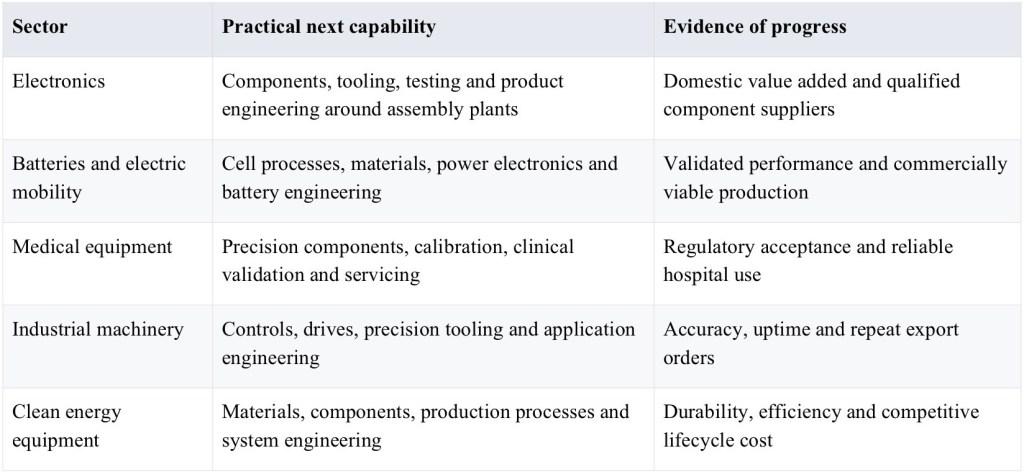
In electronics, we should ask which inputs Indian firms can make competitively and what is stopping them. Medical-equipment makers may need hospitals and testing centres to validate their products. Battery manufacturers need expertise in materials, chemistry and safety. Support should address the problem facing the particular industry.
A practical programme for India
An investor first needs a place where production can run reliably. That means usable land, dependable electricity and water, workable logistics and predictable customs procedures. Stable rules and effective dispute resolution also matter. A company investing in machinery and training needs confidence that extends beyond the next budget.
State agencies and industry associations can build supplier programmes around major manufacturers. The manufacturer would identify what it could buy locally and the standards suppliers must meet. Technical teams would assess interested firms and help them prepare. Assistance might cover equipment, certification and production trials. Firms would still have to win orders on commercial terms; joining the programme would not guarantee a sale.
Technical colleges and research institutions should work with employers on apprenticeships, testing and practical research. Agreements should explain who owns existing technology and who can use the results of new work. Confidentiality must be protected. These arrangements can give companies confidence to place more demanding engineering work in India.
Suppliers also need finance at the right time. A firm may have to buy equipment, complete trials and pay workers before its first customer payment arrives. Lenders should examine the proposed order, the firm’s technical readiness and its cash cycle. Where public support is needed, its purpose, cost and review date should be clear.
Coimbatore offers a practical setting for such an approach. An advanced-machinery investor could work with local component firms, technical colleges and a shared testing facility. A small pilot could track actual orders, quality and productivity. If the results are good, the programme could grow.
A useful policy would identify the opportunity around each major project before offering support. What could Indian firms supply? What skills are missing? Which testing facilities are needed? Who will help suppliers prepare? The answers should shape a practical programme agreed with willing investors, rather than a uniform obligation imposed on every industry.
Public support should be proportionate to additional benefits that can be verified. Programmes need clear costs, review dates and fair access for capable firms. Existing investors should also receive attention: helping an established factory add a new product or local research activity may be as valuable as attracting a new name.
Deepening manufacturing means moving towards more demanding components, processes and design work. Broadening it means bringing more Indian firms, regions and industries into competitive production networks. Both are relevant to Viksit Bharat. Neither requires every input to be made locally regardless of cost; the objective is stronger capability and higher value creation over time.
What governments should measure
Governments should distinguish investment announcements from money actually spent and factories operating. They should also distinguish local purchases from value created in India. A local supplier may rely on imported parts. Similarly, signing a technology agreement does not tell us whether Indian teams can use or improve that technology.
After five years, we should ask whether the project has created lasting technical jobs, better suppliers and repeat orders. Have defects fallen? Has productivity improved? Has research produced something customers will buy? Have exports become commercially viable? The assessment should also examine public costs, environmental performance and whether the benefits continue after incentives end. Different projects will require different targets.
Localisation should make Indian firms more competitive. Requiring local content regardless of cost or quality can have the opposite effect. Imported inputs remain useful when they improve a product or bring technology that is not yet available here. The aim is to increase Indian capability and value creation over time.
Using FDI meaningfully for Viksit Bharat
India has evidence across several industries that foreign investment can support capable factories, suppliers and technical teams. Automobiles show localisation and exports; locomotives show the role of sustained orders; medical equipment shows the value of local product development. These experiences provide a foundation for a more deliberate manufacturing strategy.
For Viksit Bharat, the next task is to make these benefits more widespread. Investment agencies should work with industry departments, technical institutions and lenders to help Indian firms take on more demanding work. The country needs both deeper capability in existing industries and a broader base in emerging ones.
FDI will serve this purpose best when foreign enterprises find a dependable production base and Indian enterprises gain lasting commercial and technical opportunities. The outcome to seek is a larger number of firms that can manufacture reliably, improve technology, pay for skilled work and compete in world markets. That is how investment can support the productive foundations of a developed India.
Sources and evidence notes
[1] Suzuki Motor Corporation. Annual Report 2019. Joint-venture history and historical local procurement rate.Open source
[2] Maruti Suzuki. Annual Integrated Report 2019–20. Supplier support and training.Open source
[3] Maruti Suzuki. Record exports in FY2024–25, April 2025. Annual exports, destinations and exports to Japan.Open source
[4] Hyundai Motor India. Thirty years in India, 2026. Company-reported cumulative sales and exports.Open source
[5] Hyundai Motor Company. 2026 CEO Investor Day roadmap. Supplier and engineer network; prospective sourcing target.Open source
[6] SIAM. Automobile Export Trends. FY2025–26 vehicle export statistics.Open source
[7] ACMA. Industry Performance Review FY2024–25, 8 July 2025. Component turnover, exports and imports.Open source
[8] ACMA. Industry report, September 2025. Areas of component import dependence.Open source
[9] World Bank. Investment Linkages and Incentives, 2020. Local sourcing and productivity spillovers.Open source
[10] OECD. Policy Toolkit for Strengthening FDI and SME Linkages, 2023. Conditions for domestic firms to absorb knowledge.Open source
[11] World Bank and Development Research Center of the State Council of China. China 2030, 2013 book edition. Technology chapter, especially printed pages 162–165. Historical assessment, not a statement of present conditions.Open source
[12] IEA. Electric Car Markets in a Time of Uncertainty. Changing sources of automotive competitiveness.Open source
[13] BYD. Hello We Are BYD, 2023. Company history and battery and vehicle development.Open source
[14] CATL. CATL and BMW memorandum on battery passports and decarbonisation, 2026. Relationship since 2012 and areas of cooperation.Open source
[15] BMW Group. Long-term battery-cell orders, 21 November 2019. CATL order volumes and planned German plant.Open source
[16] Volkswagen Group. Electrical and electronic architecture collaboration with XPENG, 17 April 2024. Joint technology development.Open source
[17] IEA. Global EV Outlook 2026 Manufacturing and trade. China production shares for 2025.Open source
[18] IEA. Global EV Outlook 2026 launch release. Chinese automakers share of worldwide electric-car sales.Open source
[19] IEA. Energy Technology Perspectives 2026 Executive summary. Sources of manufacturing competitiveness.Open source
[20] Alstom. Five years of the Indian Railways joint venture, December 2020. Equity structure and engineering contribution.Open source
[21] Alstom. 500th Madhepura electric locomotive, March 2025. Deliveries and company-reported localisation.Open source
[22] Government of India. Marhowra export programme, September 2024. Local supplier base and manufacturing site.Open source
[23] Wabtec. First Marhowra export delivery, 20 June 2025. Locomotives destined for Guinea.Open source
[24] JCB. About JCB India. Product-specific indigenisation statement.Open source
[25] JCB. 500000th construction machine, March 2024. Manufacturing facilities and export destinations.Open source
[26] Wipro GE Healthcare. Revolution Aspire launch, April 2022. Company-reported design and manufacture in India.Open source
[27] ABB. Expansion of energy-efficient drives production, May 2023. Peenya manufacturing for domestic and global customers.Open source
[28] Airbus. C295 final assembly line inauguration, 28 October 2024. Planned parts manufacture, process certification and supplier onboarding.Open source
Company disclosures and industry-association statistics are identified separately from policy recommendations. Localisation figures vary by product, period and definition. Manufacturing in India does not by itself establish Indian ownership of all technology. The aerospace partnership is included for its supplier-development lesson and is not classified here as a quantified FDI inflow.
Additional sources for the automotive production comparison
German Federal Statistical Office, Passenger car production by country, 2024: https://www.destatis.de/EN/Themes/Countries-Regions/International-Statistics/Data-Topic/Tables/BasicData_PassengerCarProduction.html
International Energy Agency, Global EV Outlook 2026, Manufacturing and trade: https://www.iea.org/reports/global-ev-outlook-2026/manufacturing-and-trade


